


Trending
- Who got the money and who didn’t in Africa’s 2025 race for foreign direct investments?
- AI’s Dual Capacity and a Strategic Opportunity for African Peace and Security
- How African economies dealt with the 2025 debt maturity wall
- Africa’s Green Economy Summit 2026 readies pipeline of investment-ready green ventures
- East Africa banks on youth-led innovation to transform food systems sector
- The Washington Accords and Rwanda DRC Peace Deal
- Binance Junior, a crypto savings account targeting children and teens debuts in Africa
- African Union Agenda 2063 and the Conflicts Threatening “The Africa We Want”


Browsing: premium
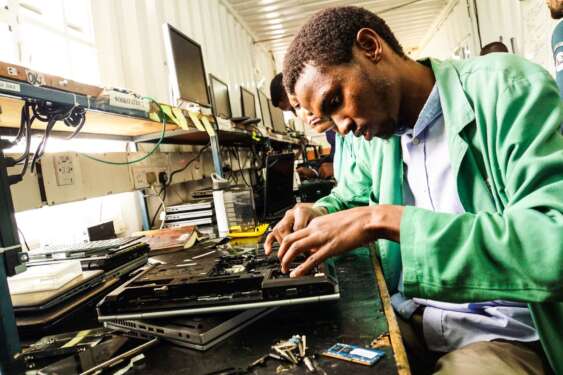
According to the Global E-Waste Monitor Report, in 2019 the world generated 53.6 million metric tonnes (Mt) of electronic waste (e-waste), and only 17.4 per cent was recycled through appropriate channels. Africa in particular lacks formal governance to support e-waste management.
Households in Africa generated 2.9 Mt of e-waste in 2019, of which only 0.9 per cent was reported to be collected and recycled by the formal sector. Discarded equipment such as phones, laptops, fridges, sensors and televisions contain substances that pose serious environmental and public health risks, particularly if treated inadequately.
Looks like Kenya is in for a tough run in the coming financial year or maybe even for a longer span. Kenya needs to borrow to meet its budgetary needs. The International Monetary Fund (IMF) is willing to lend but wants structural and governance reforms for Kenyan state-owned enterprises. How did Kenya get into this tough spot? Officials blame it on Covid-19 and the global slowed-down economy that resulted from the pandemic. Granted, economies took a hit from the pandemic but despite that fact in mind, reason still begs to understand what of the IMF loans that were issued specifically to help countries muzzle down the negative effects of the pandemic?
Notably, at the onset of the pandemic in March 2020, Kenya received a whopping $739 million loan from the IMF. The money was specifically meant to help cushion the Kenyan economy from the adverse effects of the Covid-19 pandemic. Now the IMF says Kenya is being lax.

As of October last year, Tanzania, East Africa’s Largest producer of cement, was facing so much shortage that prices almost doubled.
A 50kg bag of cement that would, on normal market weather conditions go for about USD 6 the price shot up 30 per cent to a little over USD 8, show the National Bureau of Statistics data for October 2020.
It was a paradox, and the hardliner government wouldn’t have it, newly re-appointed into power, Tanzania’s Prime Minister Kassim Majaliwa was swift to act. He ordered a nationwide inspection of all known cement factories, warehouses, distribution points and even retail shops.
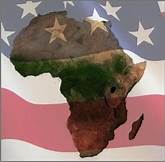
What should East Africa and Africa in general expect under a Biden led US administration? Well not to be called shitholes, that is for sure.
Africa can expect a more respectful business minded approach, and granted the move to this positive relation started pre-US 2020 elections.
Back in October 16 2020, US National Security Advisor Robert O’Brien said “America’s goal in [Africa] is to support locally led problem-solving for enterprise-driven growth, inclusive societies, and transparent, accountable governance.”

Africa’s vast lands have for a long time not been exploited for agricultural production. In fact, 61% of the world’s unused arable land is found in Africa. Little effort is being made to exploit this vast resource to feed the continent. On the flip side, the Food and Agriculture Organization says 239 million people in the region were undernourished as of 2018.
Since long before the COVID-19 pandemic, these chronic food crises have been driven by a variety of factors, including economic shocks, climate, and conflict, according to Brookings Institute.

While Africa still lags behind in the development of an interconnected web of roads, railway lines, and profitable air routes, its…
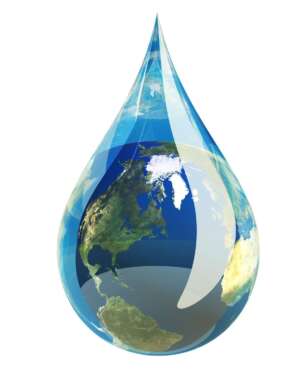
Africa and the US state of California share much in terms of terrain and their climate. Both regions are high agricultural producers while at the same time heavily affected by a changing climate which has threatened their future prospects.
However, as investors in the US look for a way of speculating and earning from water scarcity in California, there is little effort being undertaken to take advantage of the water situation in Africa for a return on investments.
Two billion people now live in countries plagued by water problems, and almost two-thirds of the world could face water shortages in just four years.
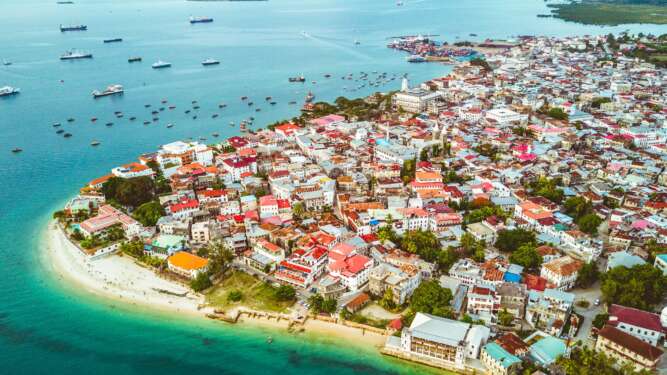
The Tanzanian central bank (Bank of Tanzania – BoT) published a detailed economic bulletin for the quarter ending September 2020, which showed Zanzibar’s economy taking a nosedive contracting by 2 per cent compared to a growth rate of 5.2 per cent in the corresponding quarter in 2019.
Zanzibar—the semi-autonomous region of Tanzania, is taking various measures to enhance economic and trade liberalization that can pave a smooth way for the private sector to get engaged in the local, regional and international arena.

Africa’s tech habitude is on the rise. Internet usage has risen significantly on the continent. On top of that, the advent of the coronavirus pandemic accelerated the prospect of growth in the digital sphere. E-commerce is one such opportunity that affords businesses access to broader market opportunities in every arena. According to McKinsey, a worldwide consulting firm, the e-commerce industry in Africa is expected to grow to a $75 billion industry by 2025.
E-commerce is growing. It is accelerated by a growing and youthful population that is increasingly exposed and has an appetite for greater efficiency and improvement of business to first-world standards. The African diaspora has also contributed to this growing demand as people have become more exposed to what is going on around the world. Technology itself dissolves existing borders and opens up trade regionally and internationally.
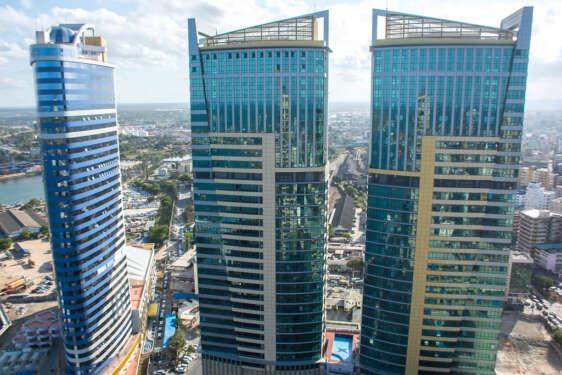
The year 2020 had a lot of events across the development aisle, and Tanzania’s economic upgrade from low to lower-middle-income status by the World Bank (WB), is worth noting as one of the success stories.
There have been a number of forecasts on the economy of Africa and Tanzania at large, with a variety of predictions which point at different directions.
On June 11 2020, the Tanzanian government confidently, via the Ministry of Finance and Planning stated that the nation’s economy is expected to grow at a rate of 5.4 per cent in 2020 compared to earlier estimates of 6.9 per cent.