Opinion

  • African oil and gas producers should also seek to maximize their own capacities as they develop their own subsurface resources.
  • Countries need to build gas-fired plants that can provide cleaner power than existing coal- and petroleum product-burning plants; liquid petroleum gas (LPG) plants that can replace traditional biomass fuels such as wood and charcoal, which contribute to health problems and deforestation; and compressed natural gas (CNG) plants that can produce fuel for vehicles.

At ADIPEC this year, I was skeptical about participating in COP 30. African nations are heading to Brazil for COP 30 in Belem.  The United States, under President Donald Trump, has closed its office of climate diplomacy and will not be sending any representatives to the event. The US is focused on energy additions and Drill Baby Drill. They are financing their energy agenda and setting the country towards an era of energy dominance. They are not …

Read More
  • Globally, content piracy costs the media and entertainment industry over $75 billion annually, with projections pushing that number to $125 billion by 2028.
  • More than 229 billion visits to piracy websites were recorded in 2023 alone, with Gen Z and millennials contributing to over 70 per cent of those visits. This isn’t just a global problem—it’s a generational one.

In Kenya today, media isn’t just entertainment—it’s the heartbeat of youth culture. It’s the Gengetone beat pulsing through TikTok dances, the graffiti on matatus turning public transport into a gallery, the viral YouTube skits that echo our humour, and the Showmax series that finally reflect our lives on screen. For a generation raised online, content is currency. It’s how we express ourselves, connect, and dream.

But behind this cultural boom, a quiet theft is unfolding. Piracy is bleeding our creative economy dry. And the most painful truth? It’s not faceless hackers …

  • For Kenya’s fast-scaling enterprises, data disorganisation is an existential threat  that leads to Massive Inefficiency where for instance ales teams waste hours, finance teams struggle to report accurately, and customer service lacks complete client visibility.
  • It also sees firms waste tech investment since sophisticated technology becomes more “expensive, complex, and ultimately futile” when applied to a chaotic data foundation.
  • What’s more, rapid growth in dynamic markets like fintech or agritech exposes every weakness, forcing companies to choose between slowing down or scaling with massive operational overhead.

Walk into any boardroom across Nairobi, Mombasa or Kisumu cities in Kenya today, and you’ll hear the same conversations echoing as business leaders excitedly discuss their latest investments in artificial intelligence, cloud migration projects, and digital transformation initiatives.

Kenyan companies are allocating substantial budgets to cutting-edge technologies, armed with the knowledge that modern tools will unlock competitive advantage, and drive the explosive growth the …

South Africa’s poultry sector is currently undergoing serious challenges. The ongoing load shedding and power disruptions have put tremendous pressure and additional costs on the industry, which makes producing poultry products extremely expensive. One company (Astral Foods) has spent an additional $47.56 million (R919 million) due to load shedding alone. This has had a significant impact on the profitability and sustainability of the company. To make matters worse – South Africa’s poultry sector has been hit with a significant avian influenza epidemic.…

  • Contrary to the general belief that Nigeria is the giant of Africa, incessant violence and armed conflicts have drastically reduced the influence of Nigeria on the continent.
  • Despite its huge resources, Nigeria still suffers from poverty, inequality, unemployment, insecurity, corruption, high fuel and commodity prices, and other political and economic hardships.
  • The biggest threats to Nigeria’s stability include bad governance, electoral mal-practices, corruption, economic hardship, inflation, terrorism, kidnapping, and ethnic divisions.

It is one of Africa’s behemoths. A country with vast resources and immense complexities. Boasting the largest economy of all states in Africa, Nigeria has long been considered one of the jewels in the crown of this continent. But, the country’s future and that of its more than 210 million people is looking bleak, which holds only dire consequences for the Economic Community of West African States (ECOWAS).

Nigeria’s high rate of inflation

“Current daily developments in political, economic, …

  • The Cortex Hub and Angel Fair Africa have reached the milestone of a decade of nurturing innovation, fostering entrepreneurship, and connecting African startups with investors.
  • The initiative aimed to create an innovation hub in the Eastern Cape to unlock the latent potential of the region’s emerging talent pool and drive technological innovation and break down barriers hindering growth.
  • It was initiated by the author, who had previously worked in the ICT field during the apartheid era and had a personal interest in driving technological advancement and economic empowerment in the region.

In a landscape defined by the ebb and flow of African entrepreneurship, milestones are more than mere time markers; they stand as beacons of progress. This year, we gather to celebrate an extraordinary achievement as both The Cortex Hub and Angel Fair Africa reach the impressive milestone of a decade. A decade of unwavering dedication to nurturing innovation, fostering …

Despite the worldwide call commanding the global business community to divest from fossil fuels and shrink their carbon footprints in the name of net zero, international oil companies (IOCs) still recognize Africa as their next frontier.…

  • A resilient health system is one that can deliver high-quality care for its patients under pressure – which could be economic, social, or environmental.
  • Achieving this requires us to proactively strive to keep people healthy, rather than waiting until they fall ill to intervene.
  • Without equity, our efforts to build a greener, healthier Africa will fall short.

Climate change is no longer a theoretical challenge to be solved by future generations; it is a reality that communities across Africa are already experiencing in the form of higher temperatures, droughts, changing rainfall patterns.

Despite contributing the least to global warming and having the lowest greenhouse gas emissions, Africans face exponential collateral damage from climate change, posing systemic risks to its water and food systems, increasing the risk of disease and straining already fragile health systems.

Nexus of climate and health

As part of a series of regional meetings in the run …

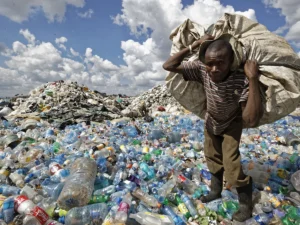
  • For businesses, adopting circular economy principles means less cost in hauling waste to dump sites.
  • Circular economy means gaining new sources of revenue from selling by-products in manufacturing and using less energy.
  • While circular economy concepts make intuitive sense to most investors, the opportunities have yet to be fully explored.

According to a new academic study published in the Frontiers in Sustainability, there are five areas of opportunities where businesses and investors can uncover wealth-building opportunities while improving the environment.

This study “Toward a preliminary research agenda for circular economy adoption in Africa”, by lead author Elke Nijman-Ross, reviewed 275 publications and analyzed the survey results of 38 circular economy experts to uncover the consensus for identified opportunities for further exploration of the circular economy in African countries including Kenya, Rwanda, Tanzania, Ethiopia, Uganda, DRC and Mozambique in East Africa. 

The concept of a circular economy, described by

Exit mobile version