
- How Aliko Dangote’s $1 billion deal seeks to unlock Zimbabwe’s economic potential
- Tanzania’s Amsons Group grows footprint in East Africa’s cement industry
- Rwanda and Tanzania to pilot EAC’s low-cost, cross-border money transfer system
- Broken Promises by Wealthy Nations: Africa Needs to Finance its Energy Addition then Transition
- Africa’s bluetech financing: How investor education and tailored investments could unlock capital
- How Agtech, AI, and Fintech can transform Africa’s food systems
- Safaricom posts 52.1% jump in half-year net earnings to $331M, Ethiopia loss narrows
- African mergers and acquisitions set to rise in 2026 as licensing rounds open new opportunities
Browsing: Mali
- Mineral processing firm Buenassa in the DRC is developing the country’s first integrated copper and cobalt refinery.
- In Mali, Russia’s Yadran Group and a Swiss investor are collaborating with the government in a deal to process up to 200 tonnes of gold per year.
- In Angola, a $5M plant, which is expected to be operational by the end of 2025, will produce 50 kgs of gold per day.
Mineral-rich African nations are fast-tracking the development of refineries and processing plants in a bid to reduce raw exports, boost local beneficiation, and capture greater value from their mineral wealth.
This continent-wide shift toward value-added industrialization will take center stage at the upcoming African Mining Week (AMW) — the region’s leading platform for mining stakeholders.
Held under the theme “From Extraction to Beneficiation: Unlocking Africa’s Mineral Wealth,” AMW will spotlight Africa’s downstream mining ambitions and connect local players with global investors to …
- Strategic investment deepens AFC’s influence in mining infrastructure, unlocks export potential in Côte d’Ivoire and Mali.
- Both Côte d’Ivoire and Mali possess vast untapped reserves and are primed for scalable commercial extraction.
- Latest transaction also cements AFC’s deepening partnership with Mota-Engil Africa, which began in earnest in 2016.
The Africa Finance Corporation (AFC) has extended a $113.2 million (€100 million), five-year term credit line to Mota-Engil Africa (MEA), the regional affiliate of Portuguese construction heavyweight Mota-Engil Group. The facility will finance capital expenditures including heavy equipment, inventories, and site infrastructure for the execution of three high-value gold mining contracts in Côte d’Ivoire and Mali.
This deal is poised to elevate AFC’s profile as a principal enabler of resource-led growth in West Africa. The region has become a hotbed of mineral opportunity, with gold playing a dual role as a magnet for foreign direct investment and a bedrock of foreign exchange …
- Months after the Military takeover in Niger, the African Development Bank (AfDB) forecasts the country’s GDP to jump by 11.2 per cent in 2024, following growth of 4.3 per cent in 2023.
- Niger has removed its military support agreements with the French and the US, respectively.
- Niger becomes the third country, following Mali and Burkina Faso, to experience a military takeover.
Growth projections after the Military takeover in Niger
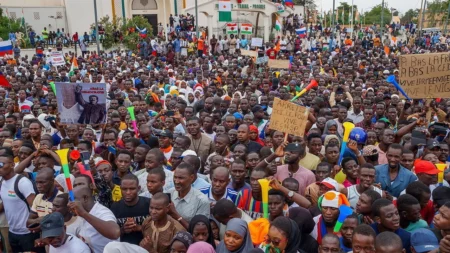
“Imperialist France”, “Down with France”, and “Chani (name of the Niger coup leader)” are a few energetic words chanted by the thousands of supporters and demonstrators who demanded the French troops leave Niger.
The latter reflects what is now referred to by the military regime as a people-led democracy. The question that then arises is; Could Africa be experiencing a withdrawal period from the grim historical chains of its colonial era, particularly the Francophone nations, Niger to be exact? (colburnschool.edu…
- Landlocked Mali, Niger and Burkina Faso lack direct access to the sea, presenting unique challenges in their future economic relationships.
- Nigeria’s imports from Niger have been on the rise, reaching $33.4 million in 2022 from $25.7 million in 2021.
- Mali witnessed a substantial surge in exports to Nigeria, posting 246% increase to $17.4 million in 2022.
In a seemingly synchronized turn of events, the West African nations of Niger, Mali, and Burkina Faso have declared their exit from the Economic Community of West African States (Ecowas).
This move announced in a joint statement on Sunday by the junta leaders of the three landlocked Sahel nations, cited their “sovereign decision” to sever ties with Ecowas without delay.
The decision by Mali, Niger, and Burkina Faso to withdraw from the Ecowas raises concerns about potential lost opportunities in trade with Nigeria, the largest economy in Africa, as well as with other countries …
- In West Africa, half of the 11.6 million individuals, who were set to receive food aid between June to August, will not get any support.
- Only about 6.2 million people will get support. They are mainly refugees, displaced individuals, malnourished children under the age of 5, pregnant and breastfeeding women, and girls.
- Populations at risk as spread across Burkina Faso, Chad, Central African Republic, Cameroon, Mali, Mauritania, Niger, and north-eastern Nigeria.
Millions of people grappling with West Africa’s hunger crisis will not receive emergency assistance between June and September due to limited funding. According to the World Food Programme (WFP), almost half of the 11.6 million individuals, who were set to receive food aid between June to August, will not get any assistance.
The shock revelation comes as WFP and authorities in the Sahel region struggle with the worst hunger crisis in 10 years.
Populations in Mali and Chad will …
According to the Central Bank of West African States (BCEAO), growth should accelerate in the WAEMU economic region in the medium term. The increased production in the tertiary and secondary sectors remains crucial. These sectors should benefit from controlling the current health crisis in the Union and the continued implementation of the NDPs.
Growth in the Union is expected to drop from 6 per cent in 2021 to 5.9 per cent in 2022 before settling at 7.2 per cent in 2023. The contribution to growth from the tertiary sector should stand at 3.5 per cent in 2023, up by 0.3 points compared to 2022. The contribution of the secondary sector should grow by 0.9 points between the two years to settle at 2.6 per cent in 2023.…
[elementor-template id="94265"]
The main objective of the bloc is to promote economic interdependence and cooperation among member states to raise the living standards and encourage economic development.
Exportation in Mali is already feeling the pressure of the political instability in the country. Exports reduced from CFA552.39 billion in the first quarter of 2021 to CFA495.87 billion in the second quarter.
Mali lists among the poorest nations in the world. According to the 2021 Index of Economic Freedom, absence of property protection rights and a transparent and honest judicial system, and the higher degree of corruption tolerance makes it impossible to achieve greater economic freedom in the country.…