


Trending
- Africa’s Green Economy Summit 2026 readies pipeline of investment-ready green ventures
- East Africa banks on youth-led innovation to transform food systems sector
- The Washington Accords and Rwanda DRC Peace Deal
- Binance Junior, a crypto savings account targeting children and teens debuts in Africa
- African Union Agenda 2063 and the Conflicts Threatening “The Africa We Want”
- New HIV prevention drug is out — can ravaged African nations afford to miss it?
- From banking to supply chains, here’s how blockchain is powering lives across Africa
- Modern railways system sparks fresh drive in Tanzania’s economic ambitions


Browsing: International Trade
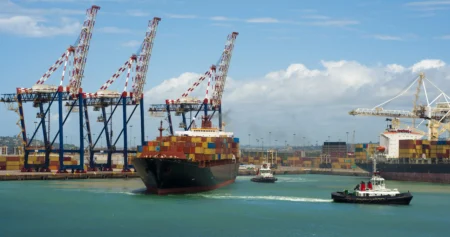
As we mark Africa Day today, our writer, Ken Mutuku, takes a deep dive into the port industry across the…

The global financial landscape has undergone a remarkable transformation in recent times. Remarkably, the issue of the de-dollarization of international trade is slowly but steadily gathering momentum. A rising trend toward de-dollarization is challenging the longstanding supremacy of the United States in the international financial system. As the dominant global reserve currency, the US dollar remains pivotal in international trade, investment, and financial transactions.
AfCFTA will be a game changer for Africa, but its success depends on certain enablers being present. The first and most obvious impediment and an obstacle to the initiative will be mustering the political will of the signatories to implement the necessary reforms to enable its success. This may not always be politically feasible or possible.
The less obvious enablers and the financial institutions on the African continent. Their presence and activities have a direct and strong bearing on the success of AfCFTA. One of the foremost bankers on the African continent, Sim Tshabalala, the chief executive of the continent’s largest banking institution by assets, is fond of saying that banking is a derived business. This means that banks butter their bread from the activities of economic agents.
If AfCFTA is to succeed in its quest to merge the various comparative advantages of the countries that constitute Africa it will need champion banks to support the intra and intercontinental trade activity from there being a single market and all participants, both local and foreign looking to make money. Africa will need champion banks to facilitate the flow of capital to worthwhile projects and ensure that the capital deployed into various activities earns the best returns for its providers.
The services Zimbabwe paid for range from software, to professional and technical services like mining exploration, servicing of complex machinery, expatriate medical aid schemes and so on.
If the country was able to develop the capability to provide these services, it would not only save on the expenditure of foreign exchange it would also earn foreign exchange.
There are 16 countries that make up the Southern African Development Community of which Zimbabwe is a part. All these countries use and pay for the same services that Zimbabwe is paying for. If Zimbabwe were to become an exporter of services to all these countries in the SADC region alone and they spent on services roughly what Zimbabwe spends on services.
The country could potentially earn (15 member states multiplied by US$ 636 million) US$ 9.5 billion annually. Adding this figure to the foreign exchange earnings reported in the monetary policy statement gives a perspective of potential Zimbabwe could realize. Developing the services sector requires substantial investment in education, tourism, information technology, and healthcare. All of these are in a sad state presently.
Before the economic shock of COVID-19, world merchandise trade in 2019 was already slowing down due to trade tensions and decelerating economic growth. …