



- Through PPPs, smart financing models, and new policies, Zambia is positioning itself as a leader in renewable energy.
- The government’s commitment to achieving universal electricity access by 2030 underpins Zambia’s solar revolution.
- One of the flagship projects is the 600MW Scaling Solar Zambia, an alliance between the government and the International Finance Corporation (IFC).
Landlocked Zambia is making a spirited push to compete favourably among African economies by tapping the power of solar energy to light up rural homes and drive industry.
With more than 70 per cent of its population living in areas where access to electricity remains a distant dream, Zambia’s solar energy drive is a beacon of hope, offering sustainable and renewable energy solutions to combat energy poverty.
This ambitious initiative is about more than electrifying homes; it’s about transforming lives, driving economic growth, and safeguarding the environment.
Through public-private partnerships, innovative financing models, and policy frameworks, Zambia is positioning itself as a leader in renewable energy on the continent.
Zambia’s Energy Poverty Dilemma
Access to electricity in Zambia is starkly different between urban and rural areas. While over 75 percent of urban residents enjoy electricity, only about 5 percent of rural households are connected to the grid. This disparity is a significant barrier to economic development, affecting education, healthcare, and small businesses.
Rural communities often rely on kerosene lamps, candles, or firewood for lighting and cooking—solutions that are neither sustainable nor safe. These traditional methods are not only costly, but also detrimental to health and the environment. Solar energy, with its affordability and renewability, is option that Zambia is tapping to bridge the energy divide.
Solar power projects illuminating rural Zambia
Zambia’s solar revolution is underpinned by the government’s commitment to achieving universal electricity access by 2030, as outlined in its Seventh National Development Plan. This vision is backed by an array of solar initiatives spearheaded by both local and international players.
One of the flagship projects, Scaling Solar Zambia, is a partnership between the Zambian government and the International Finance Corporation (IFC). Through this initiative, Zambia aims to generate 600 megawatts (MW) of solar power, a healthy leap from the 100MW targeted during its launch in 2015.
Under the program, private companies have been incentivized to invest in large-scale solar plants. For instance, Neoen, a French renewable energy company, has already completed a 54MW plant in Bangweulu in collaboration with First Solar.
Similarly, Enel Green Power, an Italian firm, has established the 34MW Ngonye solar plant, which will add clean energy to Zambia’s grid and reduce the country’s reliance on hydropower.
Solar mini-grids
Solar mini-grids are emerging as a viable alternative for off-grid rural areas, where connecting to the national grid is logistically challenging and financially burdensome. Companies such as Standard Microgrid and Zengamina Power are leading the charge.
Standard Microgrid employs a unique pay-as-you-go model, allowing rural households to access solar electricity without hefty upfront costs. Users can purchase power through mobile money, a method that aligns with the growing digital economy in Zambia. This innovation has transformed villages such as Chitandika, where solar-powered electricity is enabling children to study at night and small businesses to keep the lights on.
Meanwhile, Zengamina Power operates a hydro-solar hybrid mini-grid in Kalene. This system combines the reliability of hydroelectricity with the flexibility of solar, ensuring consistent power supply even during dry seasons.
Off-grid solar kits revolution
In addition to mini-grids, solar home systems (SHSs) are gaining traction as an affordable and scalable solution for rural households. Companies such as Fenix International, part of ENGIE, and Zola Electric have introduced modular solar kits that include panels, batteries, and LED lighting. These kits often have financing options, making them accessible to low-income families.
Fenix International’s ReadyPay Solar has been a game-changer, offering kits that power basic appliances like radios and cooling fans. The company’s “rent-to-own” model has helped households transition from costly kerosene to clean, reliable electricity.
Read also: World Bank: Africa to Emerge as Global Leader in Solar Energy Accessibility
Solar’s impact on rural economies
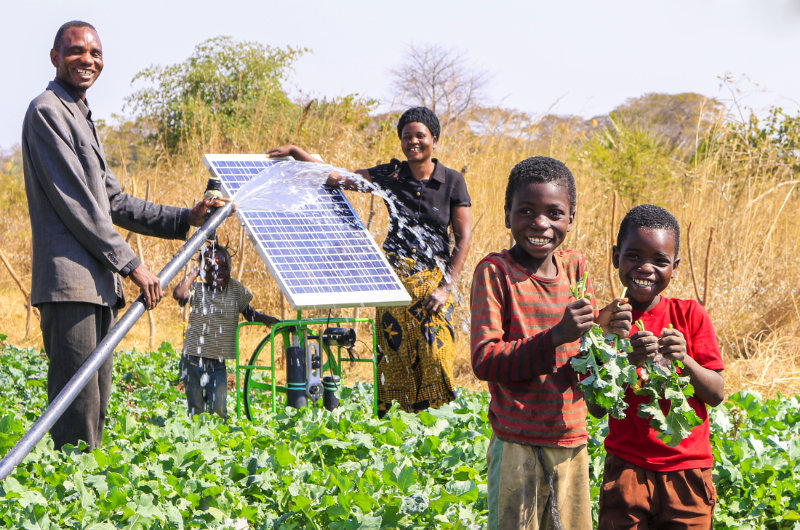
Beyond lighting homes, Zambia’s solar energy drive unlocks economic potential in rural areas. Solar-powered irrigation systems are helping farmers increase agricultural productivity, ensuring food security while reducing dependence on diesel pumps.
Solar energy has also transformed healthcare. Clinics with solar panels now operate refrigerators to store vaccines, power diagnostic equipment, and extend working hours into the night. For instance, the SolarAid project has brought solar lighting to rural health centers, improving maternal and child healthcare outcomes.
Additionally, solar-powered micro-enterprises are sprouting in rural communities. From barber shops to mobile phone charging stations, small businesses leverage solar power to increase profitability and expand services.
Zambia’s solar energy drive financing and policy bottlenecks
While Zambia’s solar energy industry is promising, challenges remain. Financing solar projects, especially for low-income households and small businesses, is still a hurdle. Innovative models like pay-as-you-go and microfinancing have mitigated these issues, but broader financial inclusion is essential.
Policy inconsistencies and bureaucratic hurdles also pose obstacles. To address these, Zambia has introduced the Renewable Energy Feed-in Tariff (REFiT) policy, encouraging private investment by guaranteeing competitive pricing for solar energy fed into the grid. The Energy Regulation Board (ERB) has also streamlined licensing processes to attract more players.
Read also: Zambia’s economic outlook for 2024 worsens as key sectors contract—IMF
International partnerships
Zambia’s solar energy ambitions have garnered international support. The Beyond the Grid Fund for Zambia, supported by the Swedish government and the United Nations Development Programme (UNDP), has brought solar electricity to over 200,000 households. The program is a testament to the power of global partnerships in tackling energy poverty.
Organizations like the African Development Bank (AfDB) are also funding large-scale solar projects under the Desert to Power Initiative, which aims to turn Africa’s vast desert areas into renewable energy hubs.
As Zambia moves closer to its universal electricity access goal, solar energy will remain at the forefront of its strategy. Key to this progress will be scaling successful models, strengthening policy frameworks, and fostering collaborations between the government, private sector, and international community.
Education and awareness campaigns are also critical to ensuring adoption. By demonstrating the tangible benefits of solar energy—cost savings, improved health, and economic growth—stakeholders can drive demand and support.
A brighter, sustainable future
Zambia’s solar energy drive is a movement that embodies resilience, innovation, and hope. By embracing renewable solutions, Zambia is reducing energy poverty and contributing to the global fight against climate change.
With continued investment, innovative policies, and global partnerships, Zambia’s solar story could become a blueprint for the rest of Africa.