




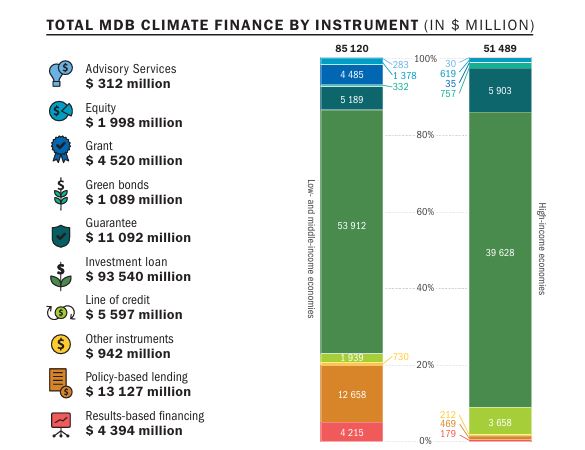
- New report shows climate finance by multilateral development banks rose 10% to $85.1 billion in 2024 compared with previous year.
- MDBs’ climate finance for low- and middle-income economies increased 14% to more than $85 billion.
- High-income economies received $51.5 billion in climate finance from multilateral lenders during the period under review.
Lenders pumped a total of $85.1 billion in climate finance to poor countries last year, reflecting a 14 per cent year-on-year increase, a new report by multilateral development banks (MDB) reveals.
According to the 2024 Multilateral Development Bank Climate Finance Report, statistics show that climate finance going to adaptation, mitigation and other projects seeking to stem the negative impact of climate change in low and middle level income economies has more than doubled since 2020.
During the year under focus, countries across Sub-Saharan Africa received $17.25 billion even as the Middle East and North Africa recorded $5.24 billion in climate finance receipts.
“As in the last two years, the joint figures for 2024 presented here show that MDBs have exceeded their ambitious 2025 climate finance targets set in 2019. From 2023 to 2024, climate finance in low- and middle income countries has grown by 14 per cent, while global climate finance across all MDB operations has increased by 10 per cent,” the report states in part.
Climate finance priority projects
The new study established that multilateral development lenders pushed a total of $58.8 billion or 69 percent of the funding to climate change mitigation efforts, while $26.3 billion or 31 percent was invested in climate adaptation initiatives. Private players in poor countries raised approximately $33 billion.
“By enabling countries and other clients to build successful climate-resilient, low-carbon economies, climate finance underpins progress on all the Sustainable Development Goals, including health, food security, clean energy, equality and decent work worldwide,” the report explains.
At the same time, the report notes that developed economies received $51.5 billion in climate finance from multilateral lenders during the period under review with $46.5 billion or 90 per cent of the funding to high income economies going to climate change mitigation while $5 billion or 10 per cent of the funds channeled to adaptation.
Across the high income economies, the study by the European Investment Bank (EIB) with participation from other MDBs, including the African Development Bank Group, shows that private players mobilized $101 billion for climate investments.
The report analysed data from multilateral lenders including the Asian Development Bank, the Asian Infrastructure Investment Bank, the Council of Europe Development Bank, the Inter-American Development Bank Group, the Islamic Development Bank, the New Development Bank and the World Bank Group.
Africa’s green potential in energy
“Africa is pushing the pedal on actions that transform Africa’s green potential in energy, nature-based solutions, innovation and a vibrant workforce,” said Anthony Nyong, African Development Bank Director for Climate Change and Green Growth.
“And we are putting climate adaptation at the heart of this effort. At the African Development Bank, we are walking the talk, we continuously meet our climate finance annual target and over half of our climate finance goes to helping African countries build resilience, protect livelihoods, and secure a climate-resilience future, while still investing in greener future.”
Overall, the study shows that private funds, which was mobilised by multilateral development lenders for climate action hit $134 billion in 2024, refelcting a 33 percent increase from the previous year.
With increased calls for cliamate action across the world, these statistics on climate finance from multilateral development banks is expected to inform debate as representatives from government and non-state actors ready for for the United Nations Climate Change Conference (COP30) in Belém, Brazil in November this year.
Initiatives to increase climate finance is expected remain a hot debate at COP30. While meeting in Baku, Azerbaijan, in November 2024, leaders around the world agreed to scale up support for developing countries to at least $1.3 trillion per year from public and private sources by 2035.
Climate finance commitments by development banks
- AfDB. For low- and middle-income economies $5.52 billion. For high-income economies $ 10 million
- Asian Development Bank. For low- and middle-income economies $12.28 billion For high-income economies $5 million
- Asian Infrastructure Investment Bank. For low- and middle-income economies $5.19 million For high-income economies $416 million
- Council of Europe Development Bank. For low- and middle-income economies $19 million For high-income economies $985 million
- European Bank for Reconstruction and Development. For low- and middle-income economies $8.1 billion For high-income economies $2.91 billion
- European Investment Bank. For low- and middle-income economies $4.45 billion For high-income economies $43.03 billion
- Inter-American Development Bank Group. For low- and middle-income economies $ 5,59 billion For high-income economies $1.27 billion
- Islamic Development Bank. For low- and middle-income economies $2.36 billion For high-income economies $27 million
- New Development Bank. For low- and middle-income economies $ 496 million For high-income economies $ –
- World Bank Group. For low- and middle-income economies $ 41 124 million For high-income economies $ 2 838 million.
Read also: Can Africa’s fragmented voice find unity at COP29 climate finance talks?