



- Many players in livestock farming across Africa remain unaware of the relationship between this sector and greenhouse gas emissions.
- Currently, livestock farming contributes about 18% of global greenhouse gas emissions according to international estimates.
- In South Africa, the sector contributes between 0.4% and 0.5% of the global total, equal to about 32.5 metric tonnes of carbon dioxide equivalents a year.
Livestock farming feeds millions of Africans, but it also leaves a carbon footprint that cannot be ignored. According to North-West University (NWU) in South Africa’s animal scientist, Prof Kenny Mnisi, this challenge is finding the balance between sustaining households and tackling climate change.
Many players in livestock farming across Africa, however, are unaware of this link to carbon footprint. Prof Mnisi says short learning programmes and collaborative initiatives are needed to close the gap.
“The Faculty of Natural and Agricultural Sciences, in collaboration with the North West Department of Agriculture and Rural Development, has set up an Agrihub,” he says. “I believe it will be critical in addressing these concerns and enabling collaborations in the country and beyond.”
Outlining the issues, Prof Mnisi says: “Although the livestock sector causes harm to the environment, it is a real-time protein factory that contributes significantly towards 12 of the United Nations’ Sustainable Development Goals. It plays a major role in the sustenance of our households, employment, nutritional security and economic stability of the country.”
Livestock farming emission estimates
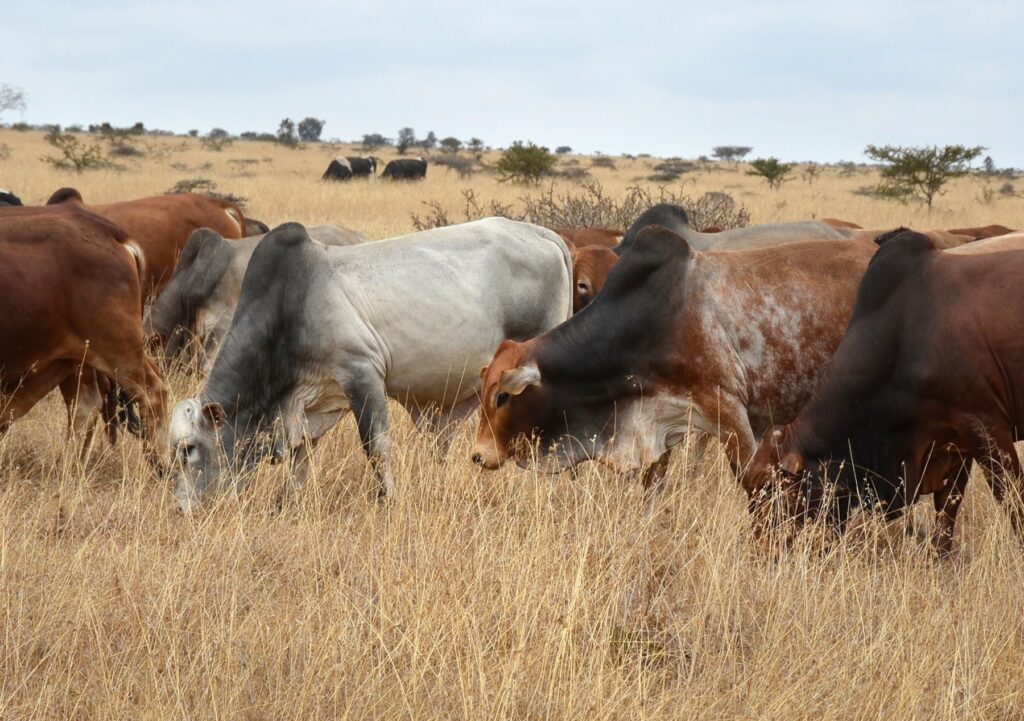
Statistics show that Africa is home to the highest population of farm animals, which account for 40 per cent of agricultural GDP across the economies. According to United Nation’s Food and Agriculture Organization (FAO), Africa hosts one in every three livestock in the world.
In 2020, FAO projections show that Africa’s livestock include over 370 million heads of cattle, over 700 million goats and sheep, over 2 billion chicken, and nearly 45 million pigs among other domestic animals, implying that total emissions from livestock farming remains significant.
Currently, livestock farming contributes about 18 per cent of global greenhouse gas emissions according to international estimates. In South Africa, the sector contributes between 0.4 per cent and 0.5 per cent of the global total, equal to about 32.5 metric tonnes of carbon dioxide equivalents a year.
Prof Mnisi cautions that while the numbers may appear small, they feed into South Africa’s ranking as the 14th largest emitter worldwide. “To have a better understanding, it is always important to consider all the major contributors such as the energy, transport and agricultural sectors, as well as industrial processes and waste.”
Read also: Tanzania’s livestock vaccination paves the way for meat export boom
Pressure rises to reduce emissions
Researchers and farmers are under pressure to reduce emissions. Prof. Mnisi notes that practices such as conservation agriculture, integrated crop-livestock systems, biogas production from manure, waste recycling, carbon farming and precision nutrition are being introduced to curb the sector’s impact.
“As animal nutritionists, we use a variety of feed additives, including enzymes, ionophores, essential oils and phytogenics to improve feed utilisation efficiency,” he explains. “By doing so we reduce enteric gas production and lower greenhouse gas emissions.”
He stresses that policy, research and farmer education must work hand in hand. Feed quality, for example, plays a leading role in determining how much methane and carbon dioxide livestock produce.
“Highly fibrous feeds result in large volumes of greenhouse gases, which explains why tropical countries are responsible for a larger proportion of enteric gas emissions than temperate developed countries,” says Prof Mnisi. Recognising what is at stake for people and the environment, Prof Mnisi and his colleagues are working for a better future.
Read also: Livestock diseases cost Sub-Saharan Africa farmers billions