

Trending
- VALR sets sights on East Africa as blockchain moves deeper into Africa’s financial system
- The cost of the data gap: Why Kenya’s lenders can’t afford to miss the full picture
- Tanzania takes EAC labour migration helm as regional rules face overhaul
- 2026 is turning out as a defining year in geopolitics, but for whom?
- Saudi Arabia and Tanzania pledge to deepen bilateral trade ties
- Tanzania rewrites its digital investment playbook
- Ethical sourcing boosting demand for Tanzania organic cotton
- DRC deploys 70,000 Ebola vaccine doses in high-stakes trial against deadly Bundibugyo strain


Browsing: International Monetary Fund
Authorities need to rework Senegal’s program with the IMF after an audit revealed a higher budget and debt deficit than…
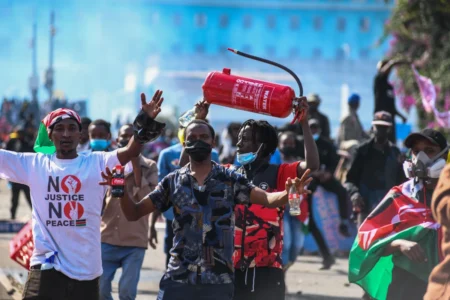
Human Rights Watch says that the focus should be on progressive revenue generation and accountability over public funds. HRW further…

President William Ruto of Kenya says resources should neither be controlled by the World Bank nor the International Monetary Fund.…

Project Management Institute’s recent Talent Gap report shows 2.3 million people will be needed each year to fill all project…
The CBE also announced in a statement that it will begin a process of phasing out Letters of credit (LCs) for import finance by December 2022.
Egyptian Prime Minister Mostafa Madbouly announced an exceptional bonus to public employees and pensioners of the state administrative apparatus and state-affiliated companies at a value of EGP 300 to meet the cost of living. The government also froze household electricity prices through June 2023.
The National bank of Egypt (NBE) issued new three-year-maturity saving certificates with an annual yield of 17.25 per cent.
Banque Misr also has raised the annual yield of the three-year saving certificates to 17.25 per cent.
These foreign exchange controls and restrictions will pose challenges for international businesses and foreign investors in Tanzania.
When introducing approvals and making them necessary for just about every kind of transaction, foreign exchange restrictions add a level of complexity to investors’ business model and implementation strategy.
The Tanzania Foreign Exchange Regulations require authorisations and justifications for several areas including exporting, importing or simply where a non-resident is directly investing in Tanzania.
While there could be a problem with income being paid outside of Tanzania for activities that are taking place in Tanzania, putting foreign exchange controls rarely constitutes the answer to encourage investors to keep their funds in the country.
Consequently, China has carefully abandoned its strong preference for bilateral dealing with problem debtors. The Chinese state avoids being a rule-taker compared to the West on debt issues. Still, it increasingly appears to recognize that multilateral approaches – ideally on an ‘a la carte’ basis – can help contain both the pressures on its African partners and its challenges.
China, therefore cautiously supported the DSSI for some African nations when it came to effect in April 2020, and similarly, the Common Framework launched in 2021. However, the slow implementation of the Common Framework brings to light four specific challenges linked to China’s role.
First is China’s discomfort with the independent and central role played by the IMF in controlling how much a country can afford to pay through its debt sustainability analysis (DSA). Second is the alarm of privates, and public sector lenders in the West over a lack of accountability in the total amount of debt China lent to African nations.
A dollar is trading at 16.67 Kwacha and 13.35 Seychelles rupees as at December 31. Both countries were among the three worst performers in 2020.
This has fueled speculation from corporate participants and currency retail traders on when exactly to exit foreign currency risks for dollar hoarders or whether to buy the Kwacha as a safer haven store for value.
President Hichilema’s government is in the process of reworking as much as $17 billion in external public debt. He has submitted an endorsement request to the IMF as his administration advances talks with creditors from US$3 billion in Eurobond holders to US$5.8 billion owed to the Republic of China.
The National Treasury is projecting real GDP growth of 6.0 per cent and 5.8 per cent for 2021 and 2022 respectively and has used the same as the basis for its revenue projections. But this adds to the overall optimism being projected.
In September 2021, the Central Bank of Kenya Governor projected a 6.1 per cent growth rate for 2021 and 5.6 per cent in 2022.
The International Monetary Fund’s most recent forecast puts 2022 growth expectations at 6.0 per cent. The World Bank, on the other hand, projects growth to print at 4.5 per cent and 4.7 per cent in 2021 and 2022 respectively.
We really believe this optimism being projected around is largely irrational and the story of Kenya’s economic growth still remains a puzzle to us.
The government of Kenya’s involvement has borne fruit. This Christmas week, KQ has increased the frequency of flights to the United States from two to four a week.
Bookings have picked up and the cost of a one-way ticket has risen from US$ 900 (KSh90,000) to US$10,00 (KSh101,305). This comes as a relief to the Kenya Airways Chairman, Michael Joseph, who had earlier said in an interview with a local station in Kenya last year that the pandemic would continue to affect demand for air travel for the next two to three years.
The airline said they had increased the number of direct flights to New York to enable families to reconnect and unite during this festive season.