




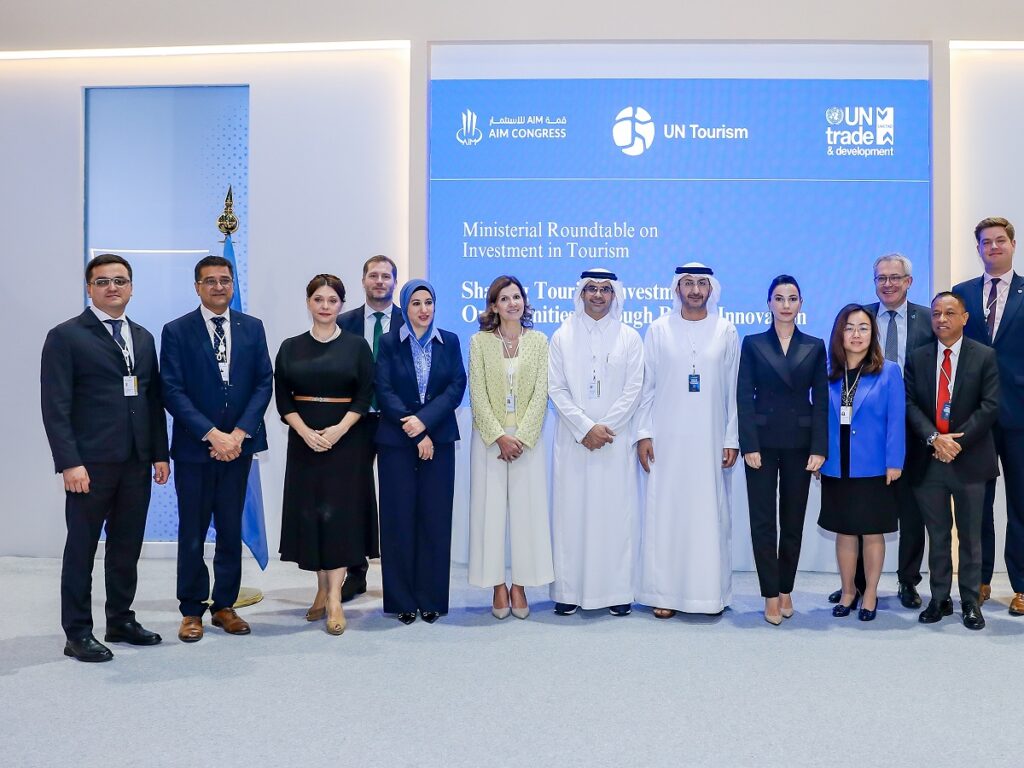
- At AIM Congress 2025, leaders underscore the pivotal role of tourism in economic resilience, job creation, and sustainable development.
- Leaders call for strategic policy transformation, with a strong emphasis on public-private partnerships.
- Digital innovation, and green financing identified as the key drivers for the sector’s future.
The Ministerial Roundtable on “Investment in Tourism: Shaping Tourism Investment Opportunities through Policy Innovation” at AIM Congress 2025 brought together ministers, policymakers, and global stakeholders to chart a new course for tourism investment.
With 13 high-profile speakers representing nations including the UAE, Bahrain, Georgia, Montenegro, Egypt, and Iran, alongside leaders from UNCTAD, UN Tourism, the World Economic Forum, ESCAP, and the World Free Zones Organization, the session underscored tourism’s pivotal role in economic resilience, job creation, and sustainable development.
The discussions centered on strategic policy transformation, with a strong emphasis on public-private partnerships, digital innovation, and green financing as key drivers for the sector’s future.
Tourism as an Economic Powerhouse: A Vision for Sustainable Growth
The roundtable opened with a powerful acknowledgment of tourism’s economic impact, particularly in post-pandemic recovery and long-term sustainability.
H.E. Abdulla Ahmed Alsaleh, Undersecretary of the UAE’s Ministry of Economy, set the tone: “Under the guidance of our wise leadership, the UAE has succeeded in consolidating its position as a global destination for investment in the tourism sector. We seek to attract AED 100 billion in new investments by 2031.”
This ambitious target reflects the UAE’s commitment to positioning itself as a leading hub for tourism innovation, balancing economic expansion with environmental stewardship.
Nan Li Collins of UNCTAD reinforced the need for resilient and eco-conscious investment frameworks, while Matthew Stephenson from the World Economic Forum highlighted digital transformation and AI as game-changers in reshaping tourism post-pandemic.
Bahrain’s Strategic Leap: Golden Licenses and a One-Stop-Shop for Investors
H.E. Fatima bint Jaafar Al Sairafi, Bahrain’s Minister of Tourism, showcased the nation’s progressive policies, including Golden Licenses—two of which are exclusively designed for tourism investments.
“Bahrain is committed to sustainable tourism and economic diversification,” she stated. “Through streamlined regulations, investor incentives, and a ‘one-stop-shop’ approach, we are making it easier than ever for global investors to partner with us.”
Bahrain’s strategy aligns with UN Sustainable Development Goals, ensuring that growth is inclusive, environmentally responsible, and economically rewarding.
Egypt’s Hospitality Revolution: Pioneering Luxury and Innovation
H.E. Yomna Elbahar, Egypt’s Vice Minister of Tourism and Antiquities, spotlighted the country’s independent strides in tourism innovation.
“We are bringing together industry pioneers to explore the future of branded living and luxury hospitality in Egypt—shaping new possibilities for the sector,” she announced.
Egypt’s focus on high-end tourism experiences signals a shift toward premium offerings, ensuring the nation remains a top-tier destination for global travelers.
Iran’s Bold New Direction: Private Sector-Led Tourism Expansion
H.E. Seyed Reza Salehi Amiri, Iran’s Minister of Tourism, unveiled a transformative vision for the country’s tourism sector. “We are opening a new chapter in Iran’s tourism—where the private sector leads, investment thrives, and opportunity multiplies,” he declared.
With new legislation and business-friendly policies, Iran aims to become a regional tourism hub, leveraging innovation, accessibility, and sustainability to attract global investors.
Georgia’s Green Tourism Vision: Where Tradition Meets Innovation
Mariam Kvrivishvili, Georgia’s Deputy Minister of Economy and Sustainable Development, emphasized the nation’s commitment to eco-tourism and green investments.
“Georgia is strategically positioned as a gateway between Europe and Asia,” she noted. “We are investing in sustainable aviation infrastructure, year-round mountain resorts, and eco-friendly tourism models to enhance our global appeal.”
With tourism contributing significantly to GDP, Georgia is reinforcing its reputation as a forward-thinking, investment-ready destination.
Montenegro’s Sustainable Shift: From Coastlines to Inland Treasures
H.E. Simonida Kordic, Montenegro’s Minister of Tourism, outlined the country’s move toward inclusive and sustainable tourism.
“We are expanding beyond coastal attractions to promote nature-based and cultural tourism inland,” she explained. “Through green licenses, solar energy investments, and public-private collaboration, we are building a resilient and eco-conscious tourism economy.”
Montenegro’s approach ensures that local communities benefit while preserving the nation’s natural beauty.
The Road Ahead: Collaboration, Innovation, and Sustainability
The session concluded with a strong consensus on the need for:
- Public-private partnerships to drive investment
- Green financing to support sustainable tourism
- Investment in human capital to empower the workforce
- Digital transformation to enhance global competitiveness
Samer AlKharashi of UN Tourism encapsulated the sentiment: “Governments must enable innovation-friendly ecosystems where tourism can thrive responsibly.”
The AIM Congress 2025 ministerial roundtable solidified a shared vision—one where policy innovation, technology, and sustainability converge to redefine tourism investment.
As nations compete and collaborate to attract capital, the future of tourism will be shaped by strategic foresight, environmental stewardship, and inclusive growth. The message is clear: The next decade belongs to those who invest wisely—and sustainably.
Read also: Global investors converge in UAE as AIM Congress launches with focus on sustainability