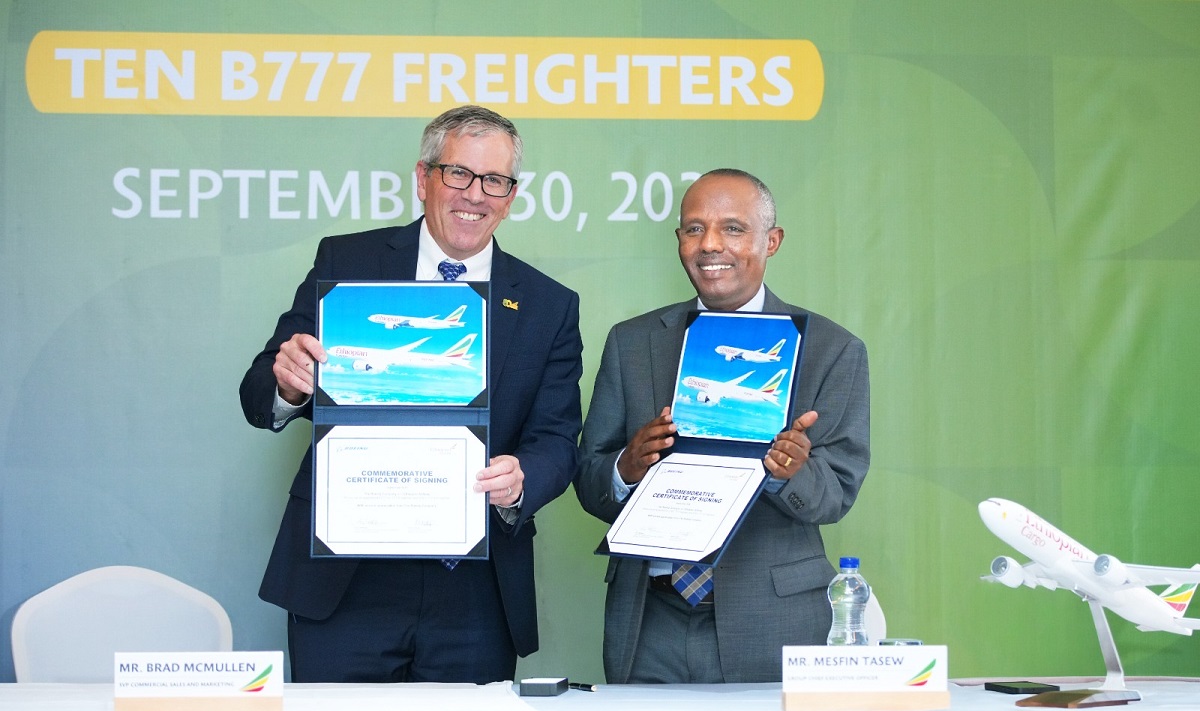



- The order is Ethiopian Airlines’ second major commitment to Boeing’s 777X family, building on its 2024 purchase of eight 777-9 passenger jets that established the carrier as Africa’s first 777X customer.
- The two 777Fs are expected to be delivered between 2027 and 2028, providing near-term capacity relief, while the eight 777-8Fs are slated for arrival between 2033 and 2035.
Ethiopian Airlines has signed a landmark agreement with Boeing for eight next-generation 777-8 Freighters and two current-generation 777F freighters, making the African carrier the continent’s first customer for the new wide-body cargo aircraft.
The order, valued at approximately $5 billion at list prices, was formalised in Addis Ababa this week and includes options for eight additional 777-8Fs.
The deal, announced on September 30, represents Ethiopian Airlines’ second major commitment to Boeing’s 777X family, building on its 2024 purchase of eight 777-9 passenger jets that established the carrier as Africa’s first 777X customer. The signing ceremony was attended by US Ambassador to Ethiopia Ervin Massinga.
Ethiopian Airlines: A Bridge and a Leap
The two 777Fs are expected to be delivered between 2027 and 2028, providing near-term capacity relief, while the eight 777-8Fs are slated for arrival between 2033 and 2035. Boeing currently expects the 777-8F to enter service around 2029, two years after the first 777-9 delivery, though the 777X programme has faced repeated delays.
That near-decade wait for the 777-8Fs explains why Ethiopian ordered a pair of the proven 777Fs alongside them. The FAA granted Boeing a critical exemption earlier this month, allowing up to 35 newly built 777Fs to receive airworthiness certificates from 2028 through 2030, despite the aircraft’s non-compliance with ICAO emissions standards that take effect on January 1, 2028.
Boeing had warned that without the exemption, the 777-8F’s certification delays would create a production gap and risk $15 billion in US exports.
Read also: Ethiopia’s reform push paying off as $13Bn investment deals dwarf regional rivals
The 777-8F Aircraft
The 777-8F is billed by Boeing as the world’s largest and most capable twin-engine freighter. It offers a maximum structural payload of 118 tonnes, compared to the 777F’s 107 tonnes, and can carry 31 main-deck pallets, a 17 percent volume increase over its predecessor. Boeing claims 30 percent better fuel efficiency, 25 percent lower operating costs per tonne, and a significantly smaller noise footprint.
For Ethiopian Airlines, the 777-8F retains the 777F’s cross-sections, walkways, and ability to carry outsize cargo, allowing seamless integration into existing operations.
An Airline in Expansion Mode
The order is the clearest signal yet of Ethiopian Airlines’ ambitions to become a cargo hub rival to Doha and Dubai. The carrier moved 897,000 tonnes of cargo in its 2025/2026 fiscal year, a 16 percent increase, and reported record revenue of $9.1 billion. Its freight network spans more than 70 markets across Africa, Asia, Europe, the Middle East, and North America.
“This agreement marks another significant milestone in strengthening Ethiopian Airlines’ cargo capabilities,” said Mesfin Tasew, Group CEO. “These aircraft will play a vital role in facilitating global trade, strengthening supply chain connectivity, and further reinforcing Ethiopia’s position as a leading cargo gateway between Africa and international markets.”
Ethiopian’s Vision 2040 strategy targets 1.9 million tonnes of annual cargo throughput, supported by the $12.5 billion Bishoftu airport project expected to handle 3.7 million tonnes at full build-out. The airline already operates 12 777Fs, two 767Fs, and four 737-800SFs.
Market Timing
The order lands in a freight market reshaped by geopolitical shock. When Middle East conflict escalated in February 2026, 12 percent of global air cargo capacity vanished overnight, according to Xeneta. Global air cargo rates rose 17 percent year-on-year in the first half of 2026, with spot rates peaking around 40 percent above 2025 levels in May.
Ethiopian Airlines benefited from diverted traffic as Gulf hubs were disrupted. Xeneta’s Niall van de Wouw noted that “air freight charters were back operational within days” after the initial shock, underscoring the resilience of dedicated freighter operations.
The order also serves as a competitive response to Airbus, which has been courting African carriers with the A350F. Boeing had 38 unfilled 777F orders at the end of August, but the FAA exemption opens room for additional sales beyond that backlog.
What Comes Next
Boeing faces the challenge of delivering on its 777-8F promises while managing the 777X certification timeline. The first 777-8F is in final assembly, and Boeing has extended its range specification to 5,000 nautical miles with a 110-tonne payload, up from the originally published 4,400 nautical miles.