


- On the sidelines of the UNGA 2026 meetings, Accra Reset summit launches financing mechanism, accountability body and new North-South dialogue as aid cuts force poor countries to take ownership of their own systems.
A coalition of heads of state and former leaders have launched a sweeping blueprint to reshape how global health is governed and financed, marking one year since the Accra Reset was unveiled on the sidelines of the UN General Assembly.
The Principal Report of the Accra Reset High-Level Panel, presented to the initiative’s Presidential Council in New York on Monday, sets out 10 recommendations to transform how health priorities are set, financed, delivered and governed, from the perspective of the countries the system is meant to serve.
It was accompanied by early blueprints for HINGE, a financing mechanism to translate the strategy into implementation, and RIO, a new global accountability mechanism to track progress and results.
The proposals land amid major cuts to international aid and mounting pressure on governments to take greater ownership of their health systems. The panel was co-chaired by Priscila Ferraz Soares, Budi Gunadi Sadikin, Peter Piot and Elhadj As Sy, and its report will carry ten key recommendations, including a “one-stop country compact,” one plan, one budget, one platform within 12 months, and a financing transition that treats domestic resources as the foundation while redirecting external money.
Driving global health goals
Other recommendations include delegating mandates to regional institutions with member-state financing and pooled mechanisms; building an equitable innovation ecosystem with regional trial platforms and assured demand; manufacturing investment underpinned by a regional division of labour and full-process technology transfer; procurement coalitions to turn fragmented demand into market power; collective financing of global public goods beyond aid budgets; and national health emergency operations centres within 12 months.
The panel also calls for reform of global health institutions, to “commit, collaborate, consolidate, close” where necessary, and independent accountability, with public scoring of who delivered within six months.
“A more sovereign-led model requires more than a change in rhetoric — it requires the institutions, financing mechanisms, negotiating capacity and partnerships capable of turning national priorities into results,” the Accra Reset said in a statement.
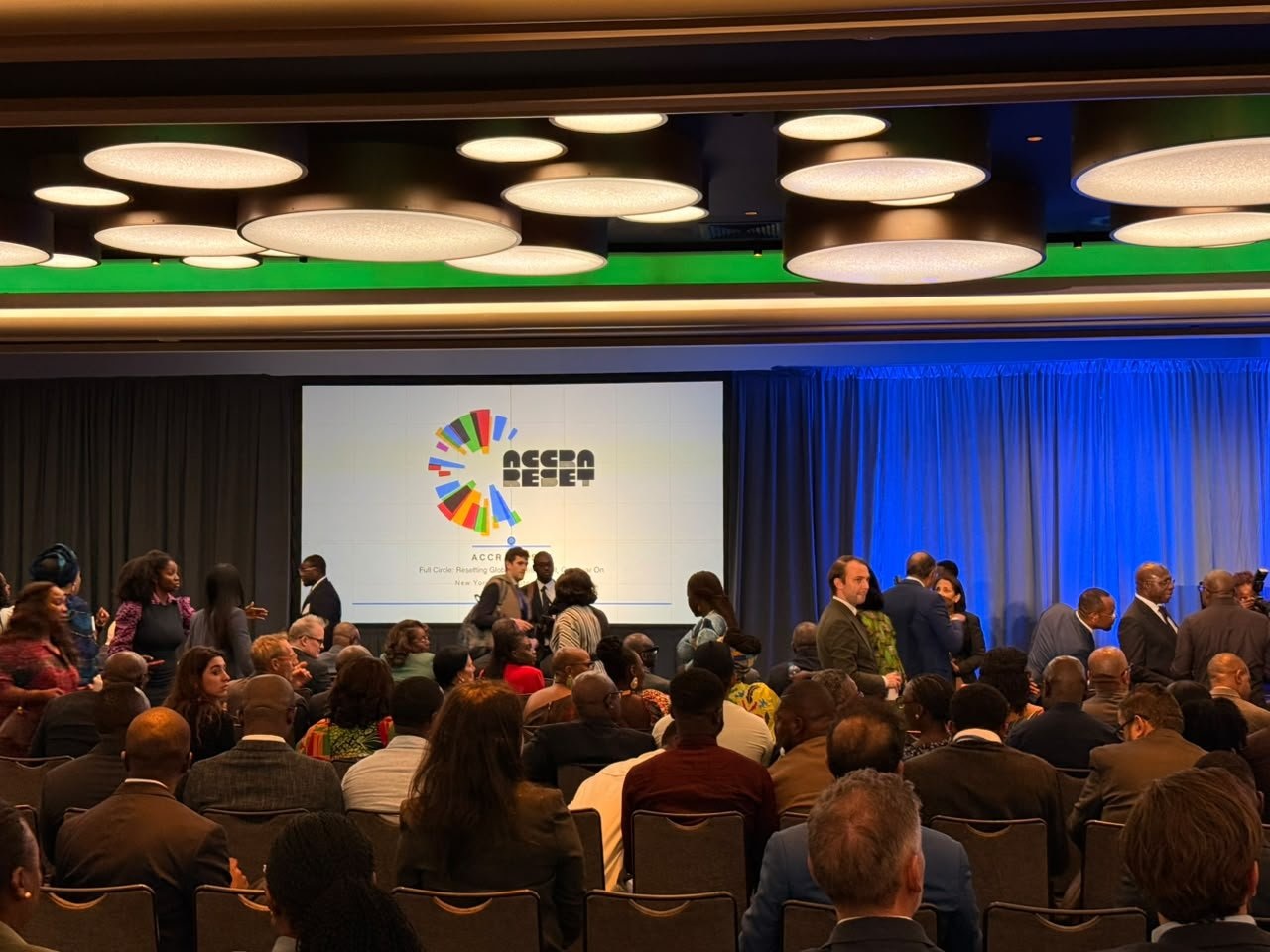
The recommendations were launched at “Full Circle: Resetting Global Development,” held at the New York Marriott Marquis and bringing together serving and former heads of state and government from four continents, alongside the heads of the World Health Organization, the OECD, the Commonwealth, the AfCFTA Secretariat and the International Finance Corporation, as well as the Chair of the Group of 77 and China.
Attendees included Presidents John Mahama of Ghana, William Ruto of Kenya, Mia Mottley of Barbados, Netumbo Nandi-Ndaitwah of Namibia and Samia Suluhu Hassan of Tanzania, alongside former leaders Olusegun Obasanjo, Laura Chinchilla, Ellen Johnson-Sirleaf and Gordon Brown. Dr. Tedros Adhanom Ghebreyesus, Matthias Cormann, Wamkele Mene and Makhtar Diop were also listed among the guests.
The event also saw the launch of the Global Reset Dialogues, a standing platform for geopolitical and geoeconomic cooperation between the Global South and Global North, with migration, critical minerals and trade finance among its early priorities. The Dialogues are intended to give governments a forum to negotiate around shared economic interests and global public goods, developing new forms of cooperation based on mutual interests and sovereign priorities.
Heads of state also considered a “Sovereign Prosperity Spheres” concept exploring a new model for governments and businesses to mobilise private-sector investment around development priorities determined by countries themselves.
Read also: IMF, World Bank, and WHO alliance readies response for the next global health crisis
Mental and child health
Maternal and child health will serve as an early test of the approach. The Mother Africa call to action, championed by President Samia Suluhu Hassan of Tanzania, was unveiled alongside a global business-sector covenant focused on maternal health in the workplace.
Around 260,000 women worldwide die each year from causes related to pregnancy and childbirth, with roughly seven in ten maternal deaths occurring in sub-Saharan Africa. The initiatives aim to bring together political leadership, health systems and the private sector to accelerate progress on one of global health’s most persistent challenges.
Further initiatives targeted the gap between development commitments and delivery. Masterkey, championed by President William Ruto of Kenya and focused on human mobility, will seek to remove barriers preventing skills and talent from moving to where they are most needed.
The event also marked the opening in Kigali of SIGN, a new institute for sovereign negotiators, with the G7’s CONNEX initiative and the African School of Governance as strategic partners, under the high patronage of President Paul Kagame. SIGN is designed to strengthen governments’ capacity to negotiate complex international economic and development agreements and secure outcomes aligned with their own priorities.
The Accra Reset was launched during the eightieth session of the General Assembly in September 2025, three weeks after a health sovereignty summit convened in Accra by President John Dramani Mahama on 5 August 2025. It is convened by the Accra Reset Presidential Council and hosted by AfroChampions.
The HLP SHARP report, a background technical paper and briefs on the Global Reset Dialogues were released to accredited media under embargo from 18 September.
Read also: DRC deploys 70,000 Ebola vaccine doses in high-stakes trial against deadly Bundibugyo strain