


- Tanzania has assumed the chairmanship of regional labour committee from Uganda.
- Kampala has been praised for expanding regional labour migration facilities.
- IOM supports labour migration across the EAC and in the Arab peninsula.
EAC labour migration laws may change as Tanzania assumes the new chair for the Regional Technical Advisory Committee on Labour Mobility for East Africa. Tanzania has taken over the chairmanship from Uganda and is expected to strengthen regional cooperation in managing labour migration across the East African bloc and beyond.
The handover ceremony was conducted in Tanzania’s capital Dodoma recently in a ceremony attended by Permanent Secretaries and technical experts from the Technical Advisory Committee, including officials from labour and employment institutions, immigration departments, ministries of foreign affairs, private sector stakeholders and development partners.
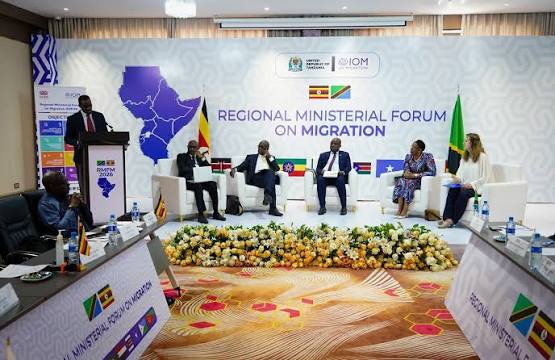
The development comes as a follow up of the March 24, 2026 7th Regional Ministerial Forum on Migration (RMFM) that was held in Uganda. During the RMFM, ministers responsible for labour, senior government officials and technical experts from across the East and Horn of Africa (EHoA) gathered to deliberate labour migration issues.
That meeting brought together 11 member states: Burundi, Djibouti, Eritrea, Ethiopia, Kenya, Rwanda, South Sudan, Somalia, Sudan, Tanzania and Uganda, in the presence of international observer countries.
Key partners included the African Union Commission, the Intergovernmental Authority on Development (IGAD), the East African Community (EAC), development partners, UN agencies and diplomatic missions.
Also present were ministers and labour experts from the Gulf Cooperation Council (GCC) countries, as well as Lebanon and Jordan.
In her speech during the event, Tanzania’s Permanent Secretary in the Prime Minister’s Office – Labour, Employment and Industrial Relations, Mary Maganga underscored Tanzania’s commitment to regional integration.
She noted that labour migration is a key factor of the long sought regional integration and maintained that the Government of Tanzania will work to build on the strong foundation established during Uganda’s chairmanship.
“Tanzania will continue to strengthen regional cooperation, policy dialogue and coordinated measures for managing safe labour migration,” the PS affirmed.
The Permanent Secretary added that labour mobility is incorporated into Tanzania’s development agenda, including the National Development Vision 2050, which seeks to build a competitive, inclusive and high-income economy while improving the lives of all citizens.
Emphasizing the point, she said; “Tanzania has taken steps to strengthen employment creation and labour mobility. These include the National Skills Development Programme, strengthening employment services and labour market information systems, as well as promoting decent employment practices.”
On his side, Uganda’s Permanent Secretary of Uganda’s Ministry of Gender, Labour and Social Development, Commissioner for Employment Services Dr Lawrence Egulu said the region is experiencing growing labour migration numbers especially movement of workers from East and the Horn of Africa to Gulf countries in the Middle East and other parts of the world in search of employment.
Dr. Egulu urged Tanzania to encourage member states to work closely with the International Organization for Migration (IOM) to ensure labour migration serves as a positive driver of development, security and regional cooperation.
Present at the event was the IOM Uganda Chief Sanusi Savage who underlined Uganda’s achievement during its tenure. Savage noted that efforts to manage labour migration in the region must be paramount in all regional development agendas.
He urged for an increase of initiatives to harness opportunities and benefits to be gained from migration such as remittances from citizens working abroad, skills development and investment.
Also Read: Tanzania rewrites its digital investment playbook
EAC labour migration key to regional development
Labour migration is a key aspect of regional development and plays a central role in promoting regional integration in the East Africa Community (EAC). As noted during the 7th Regional Ministerial Forum on Migration (RMFM), labour migration across the EAC (and the Horn of Africa as well as Arab countries) helps increase exchange of talents, technology and culture which overall supports integration.
Regional integration is a major development issue as highlighted in the EAC agenda. Movement of labour across borders still faces major hurdles as some EAC countries still require visas and passports for persons to move from one country to another.
According to the Wansom Consultants review of the new EAC labour committee chairmanship, the Regional Technical Advisory Committee on Labour Mobility for East and Horn of Africa countries plays a crucial role in addressing the complex issues surrounding labour migration.
“The committee’s primary objective is to ensure that regional cooperation on migrant workers aligns with international best practices, including those set by the International Labour Organization (ILO),” details the review.
It goes on to note that Tanzania’s chairmanship has significant implications for lawyers, compliance officers, and businesses operating in the region.
“As Tanzania takes the helm, stakeholders should closely monitor developments from this regional committee, as they may lead to updates to labour laws and regulations affecting cross-border worker movements,” analysts caution in the review.
According to the document, there are potential changes that will occur and that could have far-reaching consequences for employers, employees, and migrant workers alike.
“It is essential for all parties involved to stay informed about the latest developments and adapt their strategies accordingly…by doing so, they can ensure compliance with evolving regional labour laws and regulations,” details the review.
It further notes that, Tanzania’s chairmanship has come at a ‘critical juncture, as member states continue to grapple with challenges related to labour mobility in East Africa.’
Notably, the East African Community (EAC) has an established framework for labour laws and regulations that are designed to facilitate cross-border worker movements.
“However, the implementation of these laws remains a subject of debate among member states…Tanzania’s leadership is expected to bring about renewed momentum in addressing these challenges and promoting regional cooperation,” the review concludes.