


- Transaction marks Africa’s first DFI-backed social Financial Loss-Absorbing Capacity (FLAC) instrument on the Johannesburg Stock Exchange JSE, unlocking critical capital for small businesses and women entrepreneurs.
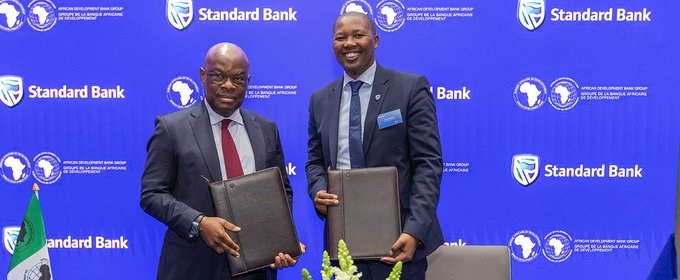
The African Development Bank (AfDB) has invested $332 million (ZAR 5.4 billion) in a landmark capital markets security issued by Standard Bank Group, Africa’s largest lender by assets.
The social bond is designed to dramatically expand financing for small and medium-sized enterprises (SMEs) across South Africa, addressing a persistent funding gap that has constrained the sector, which accounts for 60 per cent of national employment.
The transaction, announced on Thursday, is structured as a Financial Loss-Absorbing Capacity (FLAC) instrument, a new class of debt introduced by the South African Reserve Bank in January 2026.
Issued as a social bond on the Johannesburg Stock Exchange (JSE), it is the first such instrument on the exchange to target the social use of proceeds, marking a significant evolution in the country’s banking resolution framework.
Social bond deal boosts financial stability and inclusive growth
The deal is a dual-pronged strategy: it strengthens the resilience of the banking system while channeling much-needed long-term capital into the real economy. Kennedy Mbekeani, the AfDB’s Director General for Southern Africa, emphasized the strategic nature of the investment.
“This investment reflects the African Development Bank’s commitment to strengthening Africa’s financial architecture while directing long-term capital to where it is needed most—South Africa’s small businesses and entrepreneurs,” Mbekeani said. “By partnering with Standard Bank Group, we are simultaneously helping to build a more resilient banking system and supporting the SMEs that drive jobs and inclusive growth”.
Addressing the Gender Financing Gap
Complementing the $332 million facility, the Bank’s Affirmative Finance Action for Women in Africa (AFAWA) programme is providing a $1 million (ZAR 16 million) Technical Assistance grant from the We-Fi window.
This grant is specifically aimed at dismantling barriers faced by women entrepreneurs, who often struggle to access finance due to a lack of verifiable credit histories and systemic bias.
The support will fund digital payment tools to help build credit records and deliver enterprise development support for women-led SMEs. This is a crucial intervention in a country where women entrepreneurs face a staggering $5 billion financing gap. Standard Bank has committed to allocating the full ZAR 5.4 billion to SMEs, including women-led businesses, in recognition of this persistent disparity.
Standard Bank’s Commitment to SME Growth
Additionally, the deal deepens a partnership between the two institutions dating back to 2008. It builds on a November 2024 approval of a ZAR 3.6 billion subordinated debt facility and a $200 million risk participation agreement.
That previous facility has already demonstrated the demand for such support: as of December 2025, Standard Bank had fully utilized it, supporting 5,425 SMEs, exceeding its target of 4,000, with loans flowing to agriculture, retail, wholesale trade, and manufacturing.
Luvuyo Masinda, Chief Executive of Corporate and Investment Banking at Standard Bank Group, hailed the transaction as a continuation of a successful partnership. “We are delighted to close another landmark transaction with the AfDB, following the successful 2024 transactions,” Masinda said. “This social FLAC issuance will further enable the group to deliver on our purpose—’Africa is our home; we drive her growth’”.
Bill Blackie, Chief Executive of Business and Commercial Banking, echoed this sentiment, highlighting the catalytic nature of the funding. “We see first-hand the critical role that SMEs play in driving prosperity and job creation… We are especially excited about the technical assistance grant, which will allow us to fund key initiatives that deliver direct, tangible benefits to women-led SMEs,” Blackie added.
Read also: Standard Bank hits $1.2 billion in Yuan payments as China-Africa trade surges
Catalyzing a New Standard
The transaction is structured to encourage the adoption of international best practices in banking across the continent. By listing the FLAC instrument on the JSE, the partners aim to set a precedent for future development finance interventions.
“This transaction is designed to be catalytic, encouraging the broader adoption of international best practice in banking across the African continent,” said Ahmed Attout, Director of the Financial Sector Development Department at the African Development Bank.
With the 2024 facility already delivering tangible results, this new injection of capital and technical expertise is poised to provide a significant boost to South Africa’s SME sector, fostering job creation and supporting the entrepreneurs who form the backbone of the economy.