



- Standard Bank has processed over CNY 8 billion (US$1.2 billion) in transactions via China’s Cross-Border Interbank Payment System (CIPS) in its first year of operation.
- China-Africa two-way trade hit US$203.5 billion in the first half of 2026, a 24 per cent year-on-year increase, according to Chinese customs data. Chinese exports to Africa rose 26.2 per cent to US$130 billion, while imports from the continent grew 20.3 per cent to US$73.5 billion.
Bank has processed over CNY 8 billion (US$1.2 billion) in transactions via China’s Cross-Border Interbank Payment System (CIPS) in its first year of operation, a milestone that underscores the rapid financial integration between Africa and its largest trading partner.
The Johannesburg-based lender, the continent’s largest by assets, was granted direct CIPS access in June 2025.
Since then, the service has expanded from South Africa to Angola, Ghana, Kenya, Lesotho and Tanzania, enabling direct renminbi settlement that reduces reliance on intermediary currencies.
China-Africa two-way trade and role of Standard Bank
The announcement comes amid record trade volumes. China-Africa two-way trade hit US$203.5 billion in the first half of 2026, a 24 per cent year-on-year increase, according to Chinese customs data. Chinese exports to Africa rose 26.2 per cent to US$130 billion, while imports from the continent grew 20.3 per cent to US$73.5 billion.
However, the widening trade deficit, reaching $56.5 billion, reflects persistent structural imbalances. Africa continues to export predominantly low-value commodities while importing higher-value manufactured goods from China.
Beijing has moved to address this through a comprehensive zero-tariff policy covering all 53 African countries with diplomatic ties, effective from May 2026. This builds on earlier duty-free treatment for 33 least-developed nations. Chinese imports from Africa jumped 23.5% year-on-year in May and June following the policy rollout.
Read also: Here is how investors in Africa will benefit from China’s zero tariff
China’s zero-tariff initiative
China’s zero-tariff initiative has been welcomed but experts caution that market access alone is insufficient without industrial capacity building. “Opportunity doesn’t equal a development outcome by itself,” said Wang Jinjie, research professor at Peking University.
Standard Bank’s CIPS performance reflects shifting business preferences. The bank’s Africa Trade Barometer (Issue 5) shows Asian countries are now preferred trading partners for an average of 35 per cent of surveyed businesses across 10 African markets, up from 24 per cent in 2024. China dominates as the leading source of inputs, cited by 67 per cent of firms, driven by competitive pricing, product variety and supply-chain reliability.
The trade barometer also reveals improving trade-enabling infrastructure across the continent, with firms reporting simultaneous improvements in power, telecommunications, roads, rail, ports and digital border systems for the first time.
East Africa emerged as the strongest-performing sub-region, recording a 10-percentage-point increase in export activity.
Mobile money integration
Digital payments now facilitate 78 per cent of cross-border sales and 79 per cent of purchases, driven by bank-led platforms and mobile money integration.
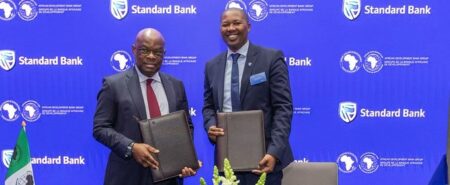
“We see CIPS as a critical enabler of this transformation, strengthening Africa’s connectivity to global markets,” said Ontiretse Modise, Standard Bank’s Head of Payments for Corporate and Investment Banking. The bank plans to extend CIPS access to more African countries by year-end.
In a related development, Angola’s Banco de Fomento Angola (BFA), the country’s second-largest lender, is preparing to join CIPS to meet growing client demand for direct yuan settlement, a source told Reuters.
Angola’s central bank recently added the yuan to currencies eligible for commercial banks’ reserve requirements. Last month, Standard Bank and ICBC were jointly authorised by the People’s Bank of China to clear RMB transactions across 19 African nations as the first “Renminbi Clearing Bank of Africa”.