

- Vivo Energy unveils strategic expansion into the Middle East with Jordan acquisition
- Will China’s Renminbi Clearing Bank of Africa push out the dollar?
- How egg prices could shape Kenya’s Central Bank key loan rate decision
- Standard Bank’s renminbi clearing status places lender at the centre of a $300bn Africa-China trade corridor
- Grey stirs Ethiopia’s digital frontier as remittance bottlenecks choke Africa’s next giant
- Uganda’s quiet bid to challenge Kenya in horticulture exports
- Kenya signs $1.2bn JKIA upgrade deal with China’s CRBC but legal cloud looms over tender
- Legal chaos in Kenya threatens to derail $2.3 billion Asahi-EABL landmark deal
Africa
EBC Financial Group says shortfalls in home grown food, high fuel costs and poorly matched farm loans may be keeping Kenya’s food prices high,…
Kenya still sets the pace in East African horticulture exports.…
Family Bank marks largest private-sector listing on the Nairobi Securities…
According to the Central Bank of West African States (BCEAO), growth should accelerate in the WAEMU economic region in the medium term. The increased production in the tertiary and secondary sectors remains crucial. These sectors should benefit from controlling the current health crisis in the Union and the continued implementation of the NDPs.
Growth in the Union is expected to drop from 6 per cent in 2021 to 5.9 per cent in 2022 before settling at 7.2 per cent in 2023. The contribution to growth from the tertiary sector should stand at 3.5 per cent in 2023, up by 0.3 points compared to 2022. The contribution of the secondary sector should grow by 0.9 points between the two years to settle at 2.6 per cent in 2023.
Economies the world over have made significant recoveries from the effects of the Covid-19 pandemic,…
Should a common currency in the EAC come to fruition, the trade will be fueled…
Remittance flows to developing regions were shaped by several factors in 2022 including reopening of…
The New Tanzania Investment Act 2022 has now become law replacing the Tanzania Investment Act…
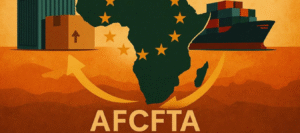
AfCFTA’s successful implementation can boost trade and promote Africa’s economic recovery and growth. The AfCFTA is the world’s most extensive free trade area in terms of size and number of nations, with a combined GDP of around $3.4 trillion.
Increased integration would improve incomes, generate employment, stimulate investment, and make establishing regional supply chains easier. In comparison to Africa’s external trade, intra-African trade remains tiny. In 2020, just 18 per cent of exports went to other African nations.
Recent Posts
- Vivo Energy unveils strategic expansion into the Middle East with Jordan acquisition 03.07.2026
- Will China’s Renminbi Clearing Bank of Africa push out the dollar? 01.07.2026
- How egg prices could shape Kenya’s Central Bank key loan rate decision 29.06.2026
- Standard Bank’s renminbi clearing status places lender at the centre of a $300bn Africa-China trade corridor 26.06.2026
- Grey stirs Ethiopia’s digital frontier as remittance bottlenecks choke Africa’s next giant 26.06.2026
- Uganda’s quiet bid to challenge Kenya in horticulture exports 26.06.2026
- Kenya signs $1.2bn JKIA upgrade deal with China’s CRBC but legal cloud looms over tender 24.06.2026
- Legal chaos in Kenya threatens to derail $2.3 billion Asahi-EABL landmark deal 24.06.2026
- Kenya’s Family Bank goes public, marking the Nairobi bourse’s biggest private-sector listing since 2009 23.06.2026
- We Cannot Build Unity on Silence: An Interview with Amb. Fred Ngoga on Justice and Burundi’s Future 22.06.2026