

Trending
- VALR sets sights on East Africa as blockchain moves deeper into Africa’s financial system
- The cost of the data gap: Why Kenya’s lenders can’t afford to miss the full picture
- Tanzania takes EAC labour migration helm as regional rules face overhaul
- 2026 is turning out as a defining year in geopolitics, but for whom?
- Saudi Arabia and Tanzania pledge to deepen bilateral trade ties
- Tanzania rewrites its digital investment playbook
- Ethical sourcing boosting demand for Tanzania organic cotton
- DRC deploys 70,000 Ebola vaccine doses in high-stakes trial against deadly Bundibugyo strain


Browsing: Africa COVID-19

Ghana finds itself in the classic emerging market trap. This comes from owing too much in someone else’s currency when the global economic tide turns. One ought not to read too much into an emerging economy getting creative with money or to confuse the confiscation of private assets with a more conventional process of fiscal retrenchment that would gain IMF approval. If the plan succeeds, Ghana may have saved itself from an economic meltdown, especially in a period widely considered as economic turmoil, per the World Bank’s analysis of the 2023 economy.

With African nations in desperate need of economic boosts, reinventing the continent’s pharmaceutical “wheel” as a contributor to development has become critical. This crucial venture requires public and private participation and, of course, the willingness of the West’s Big Pharma!
Most Africans lack the means to seek qualified healthcare providers for quality medication. People turn to self-help and alternative medicine to avoid medical expenditures, which are often out of reach. With less than 400 drug manufacturers to cater to the more than 1.3 billion people on the continent, millions of Africans die or suffer from protracted illnesses without consistent access to even the most essential medicines. Widespread ill health can trap people in poverty, as healthier people are more productive.
The pandemic’s effects have exacerbated Africa’s healthcare crisis in the last two years. The situation has captured the attention of investors who noted the gap between supply and demand in the pharmaceutical sector. Apart from increasing healthcare results to have more productive individuals in the economy, boosting Africa’s pharmaceutical industry may generate enormous economic value.

The challenge facing the EAC is not the lack of natural resources but the lack of high-tech industries. China is a perfect example of a country that transformed from an agricultural civilisation to an industrial one. More than 850 million individuals have been lifted out of poverty due to recent economic growth brought about by China’s industrialisation.
Without involvement in the fourth industrial revolution, the East African Community would never be able to escape its state of backwardness. Therefore, the DRC will catalyse industrial transformation inside the East African Community, Africa and the world.

Before it infects humans, Ebola ‘is introduced into the human population through close contact with the blood, secretions, organs or other bodily fluids of infected animals such as fruit bats, chimpanzees, gorillas, monkeys, forest antelope or porcupines found ill or dead or in the rain forest.
Notice the list of animals, these are very common not only in an African forest but any bushes or shrubs in any human settlement (across the world). Again, while scientists explain the epistemology of the disease, they fail to explain why after centuries of safe contact, now these animals are infecting humans.
What scientists do know is ‘Ebola then spreads through human-to-human transmission via direct contact (through broken skin or mucous membranes) with blood or body fluids of a person who is sick with or has died from Ebola.’

Every African region has felt the effects of Russia’s invasion of Ukraine, with West Africa also bearing the burden of…
The Board of Directors of the African Development Bank Group (www.AfDB.org) has approved a $20 million flexible loan to finance…
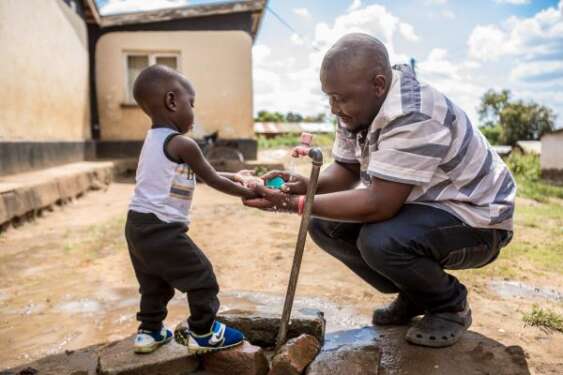
Education is the lifeline of development in Africa. At present, things are changing rapidly within the African education domain. Modern technology is now transforming learning in classrooms in South Africa, Nigeria, Kenya, Tanzania and Rwanda to mention a few.
African states, just as other nations across the globe, are experiencing economic shocks from the coronavirus (COVID-19), which forced 250 million African children to stay home.
Across the region, children were out of school for various periods. In Kenya, children remained home for the entire course of 2020 since March, while Tanzania’s school shutdown lasted for three months.