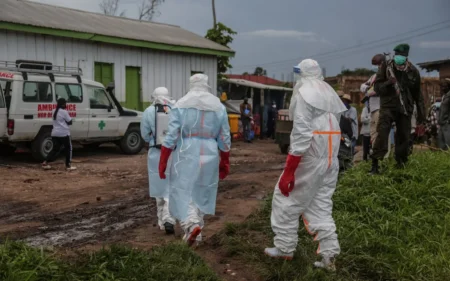





- The DRC has faced Ebola virus before, 16 times, and has ended every outbreak, observes WHO boss Dr. Tedros Ghebreyesus on seeing first-hand the intervention efforts in disease-ravaged Bunia city, East of the country. “This is the seventeenth. That history gives me real confidence… You are not alone in this. We are here, we are with you, and we will see this through together.”
- The Bundibugyo Ebola virus strain outbreak continues to evolve rapidly, with over 1000 cases reported and nearly 250 confirmed deaths, including one in Uganda.
- In DRC, WHO is working with communities, local leaders, radio stations and social media influencers to combat misinformation and encourage early tests and treatment.
In Ituri Province in the Democratic Republic of Congo, the World Health Organization (WHO) Director-General Tedros Ghebreyesus has a reassuring messages to thousands of locals reeling from the danger of rare Ebola virus Bundibugyo.
While witnessing the launch of a new treatment centre at the weekend, Dr. Ghebreyesus told Bunia population “you are not alone,” adding that the communities and the authorities in the country must work hand in hand given that no approved vaccine or treatment currently exists for the new strain.
“We are not here to tell people what to do. We are here to listen,” Dr. Ghebreyesus said, adding: “Communities understand their own challenges and their own solutions. Our role is to support you in implementing those solutions, together.”
Currently, the Bundibugyo Ebola virus strain outbreak continues to evolve rapidly, with over 1000 cases reported and nearly 250 confirmed deaths, including one in Uganda.
Across neighbouring DRC and Uganda, 134 confirmed cases and 18 confirmed deaths have been recorded as of 29 May. In addition, an American national who had treated patients in DRC is currently receiving care in Germany.
Building network of trust in epicentre country as Ebola virus spreads in East Africa
The WHO chief used his visit in the DRC to meet government officials, community leaders, humanitarian agencies and health partners, noting that there needs increased level of public confidence and community participation in order to combat the disease by eliminating the possibilities of transmission. “Community ownership is what will bring this outbreak to an end,” the WHO boss noted.
Dr. Ghebreyesus further expressed hope with efforts to engage with women’s groups, religious leaders, business representatives and young people during his visit in the DRC, describing trust-building as a process that “starts with listening.”
The UN health agency has increasingly focused on working through community networks, including local leaders, radio stations and social media influencers, to combat misinformation and encourage early detection and treatment.
Read also: U.S aid withdrawal threatens to derail HIV, Malaria and TB responses in Africa—WHO
Timely medical intervention to save lives
The current outbreak is caused by the Bundibugyo Ebola virus, a relatively rare strain of the deadly viral disease which was first identified in Uganda in 2007. While no approved vaccine or treatment currently exists, Dr. Ghebreyesus stressed that survival is possible with timely medical care.
“Ebola caused by the Bundibugyo virus can be survived with good medical care, and some people here in Ituri have already recovered,” he said. “Seeking care early makes a real difference.” At the weekend, the first case on record of recovery from the rare Ebola was announced in the DRC.
As the search for vaccines and cure intensifies, the WHO and partners are pursuing clinical trials focused on developing vaccines and treatments for the strain.
Data shows that WHO has delivered over 2,000 diagnostic test kits and helped strengthen the screening capacities at key transport hubs especially in the DRC. The agency is also improving water systems at Ebola treatment centres to support infection prevention and control in partnership with partners including the United States.
There are also deep concerns that the outbreak risks disrupting broader healthcare services in affected areas. The UN reproductive health agency, UNFPA, said health facilities were increasingly redirecting personnel, supplies and infrastructure toward Ebola response activities, reducing access to services such as emergency caesarean sections, neonatal care, contraception and postnatal support.
Read also: U.S. Withdrawal from UN Agencies: Economic Impact on Africa
Supporting a regional response targeting DRC, Uganda and South Sudan
To help maintain those services, UNFPA is deploying midwives, reproductive health kits and medical equipment while supporting a regional response plan involving DRC, Uganda and South Sudan.
“While we fight this outbreak alongside you, we are committed to ensuring that other essential health services and humanitarian assistance continue to be provided to communities across Ituri and beyond,” Dr Ghebreyesus said while expressing confidence that the outbreak can be contained.
“DRC has faced Ebola before, 16 times, and has ended every outbreak,” he said. “This is the seventeenth. That history gives me real confidence… You are not alone in this. We are here, we are with you, and we will see this through together.”
Read also: U.S. pours $162 million into rare Ebola virus fight as East and Central Africa reels