




- To combat the spread of the rare Bundibugyo strain of Ebola virus that has caused at least 246 deaths, U.S. funding has exceeded $162 million.
- In the DRC, U.S.-funded partner UNICEF has deployed 1,300 health workers and mobilized 100 motor bikes for use by contact tracing personnel on the ground.
- S. has committed $13.5 million toward Kenya’s Ebola preparedness efforts even as Washington builds an isolation centre for American citizens in a Kenyan military base.
The U.S. support to economies across East and Central Africa to combat the spread of the rare Bundibugyo strain of Ebola virus that has caused over 1,000 suspected cases and at least 246 deaths has exceeded $162 million.
In an update at the weekend, President Donald Trump’s administration said it is working with countries around the latest outbreak epicenter, the Democratic Republic of Congo (DRC), to firm up their response to the Ebola outbreak.
“The Department has also provided $350 million through OCHA pooled funds to the DRC, Uganda, and South Sudan for broader humanitarian efforts in the affected region, as part of our $1.8 billion in additional funding to OCHA announced on May 14. The Department has also mobilized an additional $50 million to OCHA’s Central Emergency Response Fund to support with the immediate establishment of up to 50 Ebola response clinics,” the U.S. media update notes in part.
In a joint statement on May 28, the U.S., Mexico and Canada said they have “aligned public health travel measures for individuals coming from African regions at greatest risk from the Ebola virus. This coordinated approach aims to protect our citizens and the millions of visitors, fans, athletes, and tourists expected during the FIFA World Cup 2026, while maintaining travel and commerce across our borders. The health and safety of every person in the region remains our highest priority as we welcome the world to North America.”
Additionally, the U.S. Department of State issued a cation on May 28 with updated information on arrival restrictions and Ebola screening. The caution states that U.S. citizens and U.S. nationals who have been present in the DRC, Uganda, or South Sudan within 21 days of arrival in the United States must only enter through designated airports for enhanced screening.
Additionally, travelers are advised to review the U.S. CDC information on what travelers need to know about returning to the United States from DRC, Uganda, and South Sudan for the list of designated airports.
The Department of State issued an updated health alert for U.S. citizens in Uganda on May 28 reiterating the recommendation against travel, providing information on border closures, and sharing CDC’s update to its Travel Health Notice from Level 1 to Level 2 (Practice Enhanced Precautions).
U.S. supporting the Regional Response on Ebola
With funding and support from the Department of State, governments, NGO implementers, and international organizations continue a comprehensive and coordinated response to contain the Ebola outbreak at its source to protect the American people and prevent further international spread.
On May 28, Secretary Rubio and Kenyan President William Ruto discussed the shared U.S.-Kenya commitment to respond to the Ebola outbreak. The United States intends to commit $13.5 million toward Kenya’s Ebola preparedness efforts even as Washington pushed forward with a contested plan to build an Ebola isolation centre for American citizens exposed to the virus on a Kenyan military base.
According to the U.S., the $162 million assistance is going a long to to among others scale up the following response activities: –
PPE Procurement and Delivery
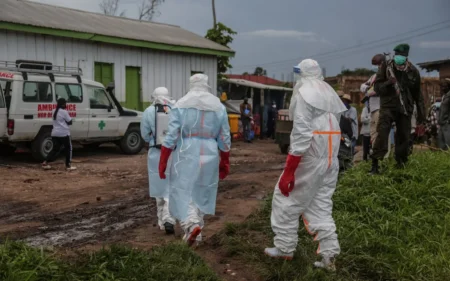
In the DRC for instance, U.S.-funded partner UNICEF has imported 100 tonnes of additional water, sanitation, and hygiene (WASH) and infection prevention and control supplies. What’s more, the International Organization for Migration (IOM) has also deployed infection prevention and control supplies, including PPE, hand hygiene materials, chlorine and disinfectant products, infrared thermometers, and screening and triage equipment.
U.S.-funded implementer Samaritan’s Purse completed two of three flights to Bunia, consisting of 24 tons of PPE and equipment for a 40‑bed treatment center.
In Uganda, U.S.-funded partner UNICEF has delivered WASH and infection prevention and control supplies to 48 health centers across high-risk districts.
Read also: Economics of pandemics: Is Ebola eradication possible?
Border Screening and Ebola Virus Surveillance
U.S.-funded partner IOM is supporting health screening and surveillance operations at multiple points-of-entry and points-of-control across Ituri Province (Bunia) and North Kivu (Beni and Goma) in the DRC.
IOM is also supporting health screening and surveillance operations at major airports in the region, including N’djili International Airport and Bunia Airport in the DRC; Entebbe International Airport and Arua Airport in Uganda; Bujumbura International Airport in Burundi; and Bole International Airport in Ethiopia.
Contact Tracing and Risk Communications
In the DRC, U.S.-funded partner UNICEF has deployed 1,300 health workers and mobilized 100 motor bikes for use by contact tracing personnel on the ground.
In the DRC, U.S.-funded implementer FHI 360 engaged media, religious leaders, and community structures to strengthen prevention messaging and prevent the spread of rumors in hotspot health zones. The organization conducted training for 40 health zone supervisors on infection prevention and control measures and held coordination meetings to support safe and dignified burials.
In Uganda, U.S.-funded partner UNICEF has oriented district health educators in 15 high-risk districts and translated risk communications materials into 10 local languages to support prevention messaging.
Read also: U.S. Withdrawal from UN Agencies: Economic Impact on Africa
Diagnostic Supplies
U.S-funded implementer FHI 360 delivered an initial 2,000 Ebola testing cartridges to the DRC to improve timely detection, identification, and reporting of Ebola cases
U.S-funded implementer FHI 360 continued to support laboratory coordination and diagnostic activities, including transportation of 310 samples from Bunia to Kinshasa.
Detection and Treatment
As part of the commitment to support up to 50 Ebola response clinics, U.S. assistance has enabled International Medical Corps (IMC) to establish five transit centers and a dedicated Ebola Treatment Unit to isolate and treat patients.
IMC is also scaling up infection prevention and control practices at 43 health clinics to help prevent transmission, screen suspect cases, and transport patients to dedicated Ebola treatment facilities.
Read also: Post-Uganda elections: 5 sectors ready for a 2026 rebound