



- Kenya’s economy grows 5.3% in first quarter, powered by manufacturing revival and tourism boom.
Kenya’s economy expanded by 5.3 per cent in the three months to March 30th 2026, accelerating from 4.9 per cent a year earlier and marking the country’s fastest first-quarter performance in three years, official data from the Kenya National Bureau of Statistics shows.
KNBS said the expansion was driven by a sharp rebound in manufacturing, a sustained tourism recovery and resilient construction activity, even as inflation edged higher and the current account deficit widened.
All major sectors recorded positive growth, reinforcing Kenya’s position as one of Africa’s fastest-growing economies despite a challenging global environment marked by Middle East tensions and volatile energy markets.
Kenya’s economy: Top performing industries
Manufacturing emerged as a key driver of the improved performance, with growth accelerating to 4.4 per cent in the first quarter from 2.8 per cent in the same period of 2025.
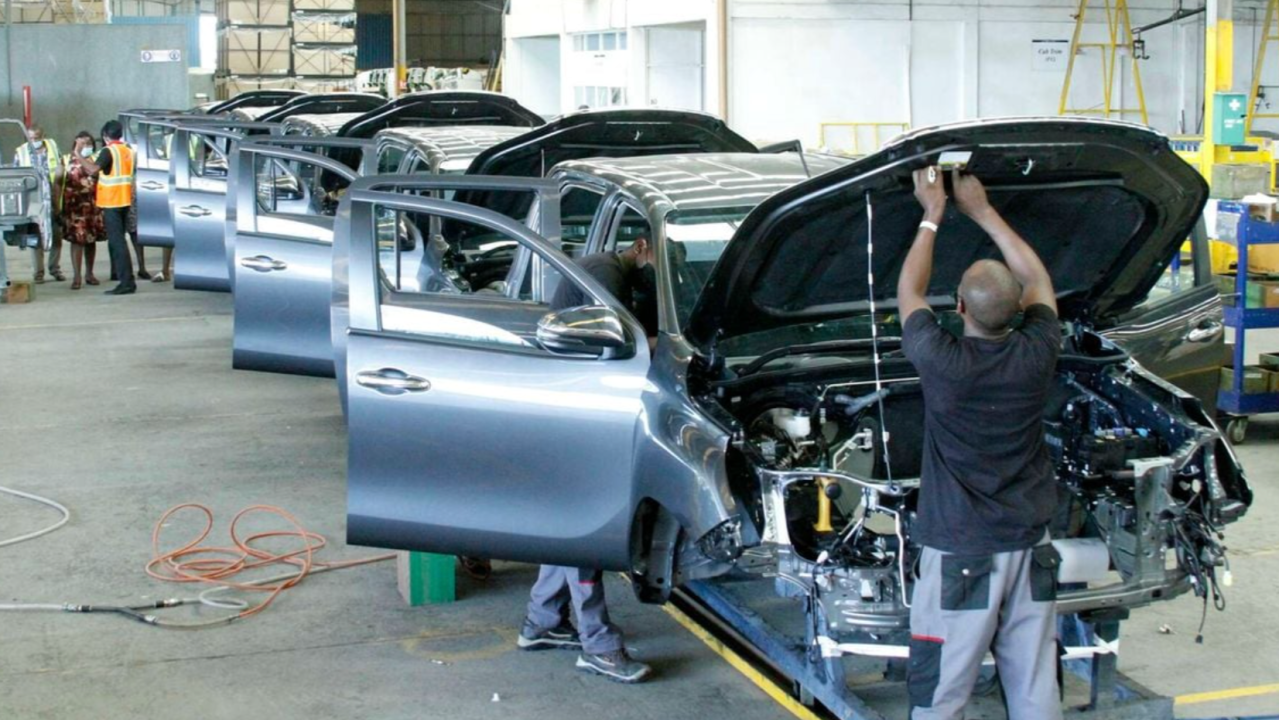
The sector benefited from increased production of sugar, soft drinks and milk in the food manufacturing sub-sector, alongside higher output of assembled vehicles, galvanised sheets, and cement in the non-food segment.
Vehicle assembly rose 18.1 per cent to 3,983 units, while cement production grew by 17.7 per cent to 2.81 million tonnes. Credit to manufacturing enterprises increased to KSh 588.0 billion by the end of March, up from KSh 566.2 billion a year earlier.
Tourism remained the standout performer. The accommodation and food services sector surged 14.7 per cent, compared with 8.0 per cent growth in the first quarter of 2025. International visitor arrivals through Jomo Kenyatta International Airport and Moi International Airport rose 13.1 per cent to 506,622 passengers.
Construction expanding
Construction gathered significant momentum, expanding by 6.6 per cent from 4.5 per cent a year earlier. Cement consumption jumped 17.9 per cent to 2.76 million tonnes, while imported bitumen and iron and steel volumes also increased. Credit to the construction sector rose sharply to KSh 200.6 billion from KSh 157.3 billion.
Agriculture, forestry and fishing, which all constitute Kenya’s largest economic sector, expanded by 4.9 per cent, slightly down from 5.3 per cent a year earlier. Tea production edged up by 3.1 per cent to 141,100 metric tonnes even as cane deliveries climbed 6.2 per cent to 2.51 million metric tonnes, though coffee production declined 6.2 per cent and fruit exports fell sharply.
The financial and insurance sector grew 6.3 per cent, up from 5.3 per cent, as lower borrowing costs began to feed through the economy. During the quarter, the Central Bank Rate was progressively reduced to 8.75 per cent in March 2026 from 10.75 per cent a year earlier, while average commercial lending rates eased to 14.70 per cent from 15.77 per cent. Private sector credit rose 8.5 per cent to KSh 5.17 trillion, while broad money supply expanded 13.1 per cent to KSh 6.98 trillion.
Read also: Lamu over Tanga: The commercial calculus that cost Tanzania $20bn refinery
ICT sector up 5 per cent
The information and communication sector grew 5.0 per cent, slowing from 5.5 per cent, as domestic mobile voice traffic increased 11.9 per cent but mobile money transaction volumes declined 13.6 per cent.
Transportation and storage sector held steady at 3.6 per cent growth, with Standard Gauge Railway cargo volumes rising 12.7 per cent to 2.05 million metric tonnes and passenger numbers up 12.3 per cent.
Despite the stronger domestic performance, external pressures persisted. The current account deficit widened to KSh 120.9 billion from KSh 70.0 billion a year earlier, while average inflation rose to 4.35 per cent from 3.45 per cent, largely reflecting higher food prices. The Kenyan shilling depreciated against most major currencies except the US dollar and Japanese yen.
The stronger-than-expected growth comes as the government pursues an ambitious domestic borrowing programme, including the recent KSh 40 billion bond auction, to bridge a KSh 1.146 trillion fiscal deficit for the 2026/27 financial year.
(I 1 USD = KSh130)