


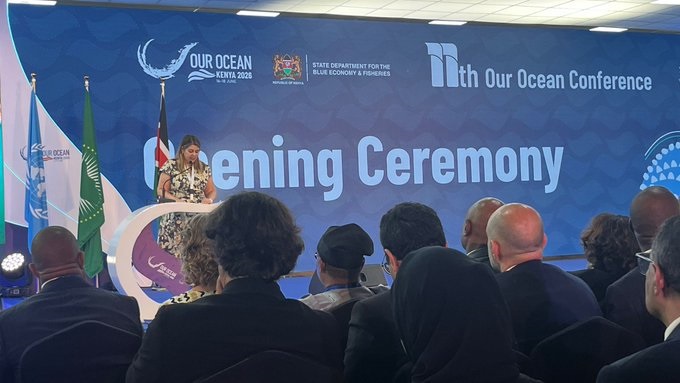
As the 11th Our Ocean Conference convenes in Mombasa, the first time this global gathering has been held on African soil, the focus shifts to a continent blessed with both immense marine wealth and profound food system challenges.
In this exclusive interview, The Exchange Africa sits down with Dr. Christina Chemtai Hicks, Professor at Lancaster University, Pew Marine Fellow, and Oceana Board member, to unpack a vision for African food systems that moves far beyond mere productivity. Dr. Hicks brings a rare perspective that bridges rigorous fisheries science with deep commitments to equity, human rights, and the lived realities of coastal communities across the continent.
At the heart of her approach is a fundamental recalibration: what would it mean to design food systems that are not just efficient, but genuinely just and resilient? Her answers challenge conventional development orthodoxy, questioning trade patterns that export high-value fish while importing processed grains, critiquing subsidies that prop up destructive industrial fishing, and centering the knowledge of small-scale fishers and women who are too often sidelined in policy conversations.
She argues that healthy diets, sustainable ecosystems and fair labour conditions are not competing priorities but inseparable dimensions of a single, integrated system.
Throughout this interview, Dr. Hicks offers concrete pathways forward, from abolishing harmful subsidies to expanding inshore exclusion zones, from empowering women in post-harvest sectors to bridging indigenous knowledge with modern science. Her vision offers a future where Africa’s oceans feed its people first, where fishers earn living wages, where traditional grains replace ultra-processed imports, and where coastal communities lead the decisions that shape their own lives.
As the Our Ocean Conference unfolds in Kenya, these are the priorities that Dr. Hicks believes must take centre stage, not as distant ideals, but as urgent, actionable imperatives for a continent whose food security and ecological health hang in the balance.
Read also: Livestock farming under pressure as Africa needs to balance food security and emission cuts
Q: Let’s define our terms. In your view, what distinguishes a just and resilient food system from a merely productive one in the African context?
A: A healthy food system, including in Africa, is one in which everyone, regardless of gender, age, ethnicity, or any other social characteristics, can access a healthy diet. There are many definitions of what a healthy diet constitutes, but they broadly align, including fruit and lots of vegetables and whole grains.
Although our traditional African whole grains (e.g. Sorghum, Millet, or Teff) are healthy and nutritious, the most commonly consumed grains, that are imported, like white rice, wheat, or maize, are processed and have been stripped of their nutrition (often to increase their shelf life).
So, we should be consuming more of our whole grains. A healthy diet also needs sufficient micronutrients- which is where fish comes in. In Africa, the quickest way to get this is through animal source proteins (<5 servings a week), and fish is a particularly healthy option as red meats can increase cholesterol levels and blood pressure.
Justice means different things to different people, including experts. One nearly universally accepted definition of what constitutes a minimal acceptable level for justice is Human Rights. If we lean into this definition, then a just food system would be one that protects the right to food for everyone, the right to decent work, the right to a healthy environment, and people’s civil and political freedoms.
This would mean that healthy foods are available, in the right places, in sufficient quantities, at affordable levels, and in an environment conducive to making healthy choices. That is, an environment free of excessive advertising for – and quantities of – unhealthy foods.
It would also mean that fishers and food system workers are afforded a living wage, so they can afford a healthy diet and live in dignity, and they are afforded protections, so they can negotiate for better pay and conditions. It would also mean our fisheries are sustainable, our climate is safe, and our environments are non-toxic and free from pollutants.
Finally, for our food system to be resilient, this all needs to happen in a way that regenerates rather than degrades our ecosystems and does not push us beyond safe planetary boundaries. If this sounds like a tall order, perhaps we should ask why affording all our citizens their basic human rights feels so far out of reach?
Read also: Biotech in Kenya: Can Innovation Guarantee National Food Security?
Q: You serve on Oceana’s board. From that vantage point, what is the single most damaging plan or policy that African governments should abolish immediately to restore fairness and ecological health?
A: Oceana is calling on governments across Africa and around the world to strengthen protections for critical marine habitats, increase transparency and accountability in fisheries, and ensure small-scale fishers and coastal communities are at the centre of ocean decision making.
We know that an investment in healthy oceans is an investment in food security, economic prosperity, and community resilience.
When fisheries are properly managed, the fish come back. And when our oceans are protected, and those protections are properly enforced, they thrive.
Around the world, depleted fish populations have rebounded when governments implemented science-based management, reduced overfishing, and strengthened accountability.
Governments can further support coastal communities by combatting illegal fishing through expanded and enforced inshore exclusion zones, which can significantly increase catches from artisanal fishers while helping rebuild fish populations and strengthen local food systems.
Q: Resilience means withstanding shocks. How can African food systems stop lurching from crisis to crisis and instead build adaptive capacity from the community level upward?
A: By relying on local and regional diversified food systems and improving the post-harvest sector by empowering the women behind it. Rebuilding fisheries and protecting coastal livelihoods by preserving inshore waters exclusively for small-scale fishers will help maintain access to fish for those who need it most. In the supply chain, providing finance to women to improve preservation and storage can help buffer between bumper crops and lean seasons, whether that’s in fisheries or other sectors.
Q: Land-based agriculture receives the overwhelming share of development finance. What would a rebalanced investment portfolio — one that treats fisheries equally — actually look like in dollar terms and programme design?
A: I’m not an economist, but I know that investing in fisheries research and management pays off. Governments must stop subsidizing destructive, industrial fishing. This money could instead be redirected toward fisheries management and science or investing in more sustainable livelihoods.
Most governments currently lack the resources to stop piracy, deter illegal and unregulated fishing, and collect the data needed to manage and rebuild fish stocks. If these resources were available, it would enable much more resilient coastal livelihoods and provide a constant return on investment.
Fisheries and aquaculture support about 15 million jobs in Africa, including millions of people engaged in small-scale and subsistence fishing. In 2022 alone, the total revenue from the first sale of small-scale fisher catch was around $10 billion ($4.3 billion from marine catch, $5.7 billion from inland catch).
Q: Many African countries export high-value fish (like Nile perch or tuna) while importing cheaper, lower-quality fish. Is this trade pattern undermining local food security in the name of forex earnings?
A: There is no avoiding the fact we do need foreign earnings, but that does not mean we open unregulated markets and do not pay attention to the knock-on effects. There does not need to be a trade-off, but decisions need to be made in a joined-up manner, and we need systems of monitoring to track the impacts of these markets. Once a market opens, it is very hard to close it.
This means we need to government agencies responsible for fisheries, speaking to the department responsible for health, and the department responsible for commerce/trade. The priority should be supplying our citizens with sufficient quantities of nutritious food that meets their dietary preferences. If we have that here, we should use it locally first. Then we can export what is left over.
Q: In your view, what role should traditional and indigenous knowledge on fishing play in designing food systems in Africa, and how can we bridge that knowledge with modern fisheries science?
A: Africans have relied on fish for millennia and traditional and indigenous knowledge will be essential to ensure that continues for future generations. From our traditional grains that hold immense health benefits to the ocean-based knowledge systems and forms of customary tenure. It is the people most connected to and dependent on the oceans and land who have the most to lose from management failures.
But they also have a lot to offer. They possess a depth and breadth of knowledge built through experience and passed down through generations that can come to bear on these issues.
This knowledge often aligns with, confirms, and has informed western based scientific knowledge, but there is also much for us to still learn from it. For example, here on the coast, the fishers know the time, the date, and the seasons from looking out to sea, to the moon, and stars. I gain this same knowledge, based on the same information, but I access it through my mobile phone.
How wonderful the world would be if I didn’t need this so much. It is not just knowledge, coastal communities have for generations developed systems to control access and limit practices, many that are also reflected in modern management methods. When these systems work together, solutions are more effective. When they ignore or oppose one another, communities clash and governance breaks down.
These facts consistently point to one thing: action is stronger and more effective in partnerships that reflect local realities, priorities, and reinforce existing systems of tenure. Empowering local leadership is therefore necessary, and there are many examples of its successes.
That’s also why I support the Small-Scale Fisheries Call to Action and the implementation of the FAO Voluntary Guidelines for Securing Sustainable Small-Scale Fisheries, because these documents imbibe these values and lay out how they can be recognised.
Q: The Our Ocean Conference is in Mombasa — the first time in Africa. What specific outcome from OOC11 would tell you that African priorities have truly been centred?
A: This conference presents an opportunity not only to address the threats facing our oceans, but also to elevate African leadership, innovation, and solutions.
I believe the conference will be a success if it prioritizes the role of small-scale fishers and coastal communities in decision making, advances habitat protections that rebuild fish populations and help safeguard us from climate change, addresses the production and use of unnecessary single-use plastics that are flooding into our oceans, and expands transparency in the fisheries sector to address illegal, unreported, and unregulated fishing and human rights abuses at sea.
If we save the oceans, we can help feed the world.
Read also: Why fish and fisheries may be Africa’s most overlooked food security solution