

Trending
- African governments drive new forest finance progress as global report warns funding globally must scale faster
- Fine Spinners eyes Kenya’s Agoa-backed apparel supply chain with $5m plant
- Why young Kenyan investors need to stop treating the stock market like a betting slip
- Tanzania tax reforms mandate VAT refunds to under 30 days
- In New York, world leaders unveil plan to overhaul global health architecture
- Minisend grows Kenya presence as official payment partner of Africa Blockchain Festival 2026
- UN resolution challenges world maps that make Africa look smaller
- Zimbabwe edges closer to arrears payment, debt restructuring and reset of ties with IMF


Browsing: zimbabwe
Once again, Heijin was at the centre of another dispute. This time around, it was displacing more villagers in Murehwa. Murehwa is a village in Mashonaland East province.
This time around, it affected up to 100 families. As with the example above, the company received a special mining grant to mine black granite in the area. The mining claim sits on a densely populated place covering between 200 & 300 hectares.
Due to the presence of granite in the area, Chinese companies are laying siege on the province. All this to get their hands on the rare and lucrative stone. Heijin’s newest intrusion follows another bloody battle between Mutoko and Shanghai Haoying Mining Investments villagers.
They have claims to mine black granite, which was. At the same time, Shanghai Haoying has compensated households who would lose their home due to mining activities. The Chinecompany’sy’s plans to establish operations in the area have met fierce opposition from angry locals.
If you received your salary on the 1st of January in ZWL, you would struggle to pay for goods and services in February. This volatile situation results in consumers seeing value eroded from their bank balances at an astonishing rate.
We see wages struggle to keep up with inflation, a phenomenon similar to 2008. Most people buy USD from the black market to retain some semblance of value in these balances.
Zimbabwe has a currency crisis, and the Authorities seem to be struggling to deal with it. The rate at which the Zimbabwe dollar is depreciating signifies the state of the economy. Much of this is being blamed on the countries foreign currency auction system.
Varun Beverages has become one of the country’s biggest beverage firms in Zimbabwe Delta has had a firm…
When exports receipts increase it means from the definition given that the country that pursues this strategy will find itself in the desired position where it earns more than it spends.
This in the long run will lead to the country becoming less reliant on balance of payments support from multilateral lenders and repaying its debt obligations.
For a country like Zimbabwe, it is imperative that the southern African country pursues this strategy as the increased foreign exchange receipts will provide desperately needed foreign currency and monetary stability.
This comes as the IMF has downgraded economic prospects for countries in this cluster. The downgrades have, however, been offset relatively by projections for some commodity producers and exporters that were upgraded on the back of rising commodity prices.
The economic prospects between wealthy nations and low-income countries are expected to be divergent and this divergence will remain of great concern to multilateral lenders and world leaders. In wealthy nations, for example, aggregate output for the cluster economies is expected to regain its pre-pandemic trend path in 2022 and exceed it by 0.9% in 2024 whereas the cluster of nations comprise emerging markets and developing economies (excluding China) will remain 5.5% below their pre-pandemic forecasts in 2024.
This event should it occur as forecast will set back improvements in living standards.
The company has been in existence for about 130 years and in that period amassed a substantial portfolio of businesses that comprise hospitality, food retail, agriculture, and security services. The large size of the company and dominance in the markets made it a darling of the Zimbabwe Stock Exchange.
At the height of its conglomerate strategy, the company owned everything from food retailers, department stores, a cotton printing company, tea estates, and a bank. Meikles was even called Kingdom Meikles Africa during its short-lived with Kingdom Financial Holdings.
The company divested its financial services interest in a demerger after an acrimonious shareholder and boardroom dispute and so began the drive to refocus its business activities around its core businesses namely retail, hospitality, security services, real estate, and agriculture. Meikles recently announced that it would be discontinuing its mining activities.
The lender stated during the conference that the country’s economic objectives were still under threat from unsustainable debt.
The government announced last week that external debt grew to US$13.7 billion in September, up from roughly US$10.7 billion the previous year.
Zimbabwe’s debt accounts for more than half of the country’s GDP.
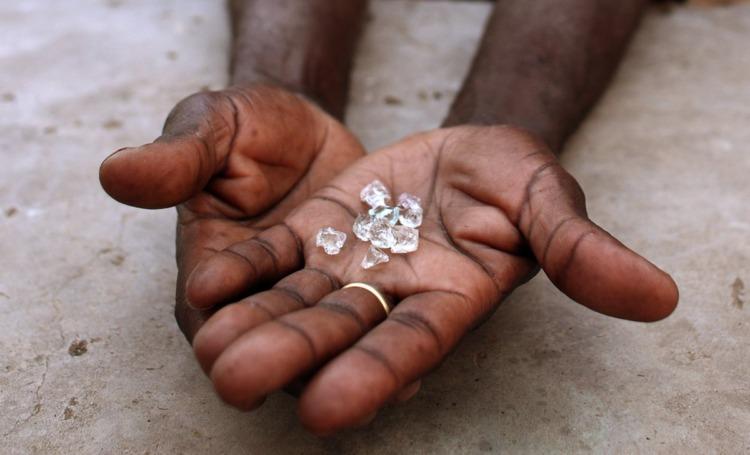
To get their hands on Zimbabwe’s diamond, they conspire with the country’s top government officials and according to the leaked papers, the corruption runs deep, all the way to the very executive.
Makes you wonder, what is hurting the Zimbabwean people more, the US sanctions or the internal usurping of millions of dollars by corrupt government officials and their international partners in crime.
Zimbabwean diamonds go for as high as USD12 000 per carat. To get a picture of how much this racket is worth, consider report findings that have revealed that 350 000 carats of round diamonds worth an estimated USD140 million dollars have disappeared from the Minerals Marketing Corporation of Zimbabwe (MMCZ) and the Zimbabwe Consolidated Diamond Company (ZCDC) repositories.
Zimbabwe chastised the West for averting Harare’s breakdown by denying “access to markets for Zimbabwe’s diamonds sector” and causing “disinvestment, corporate closures, and a currency collapse” in a document titled “Economic Impact of Sanctions on Zimbabwe.”
Zimbabwe, which is thought to hold 25% of the world’s diamond reserves, has sunk deeper into international turmoil following revelations that over USUS$14 billion had been taken by oligarchs in the Marange highlands, where the US has expressed concerns about forced labour and human rights abuses.
Security forces mercilessly attacked illegal miners around the end of 2008 to gain sole ownership of the mines for the state, prompting the West to label Harare’s jewels “blood diamonds.”
Large-scale miners supplied nine tonnes of gold over the time, according to FPR, the country’s lone buyer of gold, lagging output from small-scale producers, which delivered 13 tonnes.
Bullion output fell slightly to 1,38 tonnes in April, then jumped to 1,66 tonnes in May before soaring to 2,92 tonnes in June.
According to the study, July’s output was 2,82 tonnes before climbing to 3,17 tonnes and 3 tonnes in September and October.