

Trending
- How to assess legitimate trading platforms in Kenya using trust, transparency and risk controls
- Kenya secures landmark EU data adequacy pact in first for Africa
- Kenya’s $37.3 billion budget that promises everything except development
- UNEP lauds Ghana tree planting push, terms it continental blueprint
- Blue-Raman: What EU funded new internet cable means for EAC
- Kenya’s huge food deficit mask a deeper failure of finance, FSD Kenya reveals
- Tanzania eyes Belarusian tractor model and motor pools to unlock untapped farmland
- AI-first telcos will lead the race in Africa


Author: The Exchange

The Exchange
- We provide economic news and analysis on the investment arena in Africa, with a particular interest in doing business. Our key areas of focus include banking, capital markets, energy, mining, manufacturing and industrial development.
Harrowing tales of men, women and children drowning in the Mediterranean, after taking treacherous journeys by foot, car and boat; crossing borders in search of safer pastures has hitherto proven to be a truth stranger than fiction. However, the deadly voyages are just a tip of the iceberg of the plight suffered by refugees and migrants, who flee their native countries seeking safer havens in foreign lands. Instead, to the few who make it to the other side, they face an uncertain future. For most, this hope is extinguished upon setting foot on foreign soil, where they are met with unspeakable violence,…
The young and the restless are befitting words to vividly depict the status quo of the countless educated but unemployed African youth; a ticking time bomb threatening the future of the continent. Is it the lack of proper skill sets or the intermittent nature of opportunities that has resulted in the shrinking job market? This remains a puzzle yet to be unraveled. Upon graduation from tertiary institutions, the almost assured optimism by young people of landing top jobs on the basis of their qualifications is swiftly replaced with the icy glare of disillusionment. As desperation creeps in hope for a bright future…
Covid-19 is pushing SubSaharan Africa’s leading economies back into poverty, according to the results of GeoPoll’s six-nation survey on the financial and social impact of the pandemic across the continent. The poll of 2,400 respondents in South Africa, Nigeria, Ivory Coast, Democratic Republic of Congo, Mozambique and Kenya found rising unemployment, further falls in incomes, drastic cuts in spending on essential and non-essential items, and mounting concern over meeting bills in the three months ahead. “The picture that emerges is of a further sharp deterioration in the financial position of many individual Africans in the first quarter of 2021,” said…
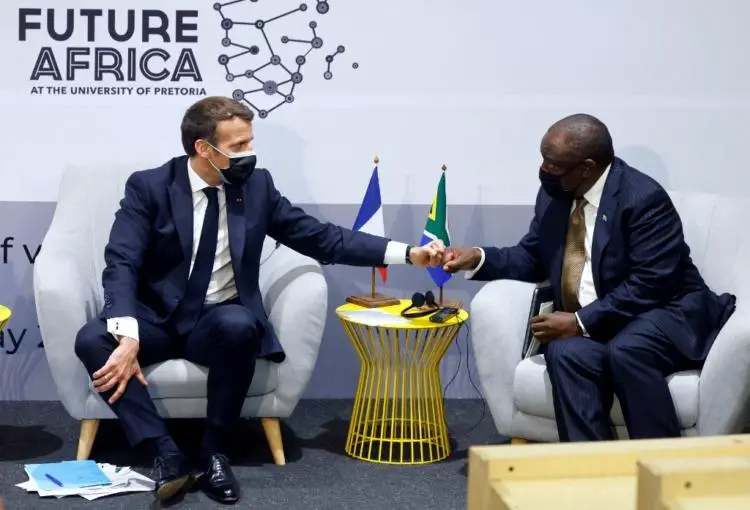
By Emmanuel Macron, Paul Kagame, Cyril Ramaphosa, and Macky Sall PARIS – The COVID-19 pandemic has taught us that we can no longer treat seemingly faraway crises as distant problems. What happens anywhere can affect people everywhere. That is why addressing the impact and legacy of the pandemic in Africa is so important. Although Africa has suffered fewer COVID-19 cases and deaths than other areas of the world, the pandemic’s impact on the continent could be more sustained, deep-rooted, and destabilizing for the entire planet. In one year, the pandemic has halted a quarter-century of steady economic growth, disrupted value…
The ceremony was attended by local and regional dignitaries – heads of states, ministers, heads of diplomatic missions and international organizational heads. H.E. Museveni in his speech gave highlights and assurance to the business community around the East African region, Africa and the world at large, stating that the National Resistance Movement (NRM), – the ruling party, stands for Pan-Africanism which translates into economic and political integration. Economic integration in this case refers to having a common market for products and freely doing business within the borders of the neighbours. This is an assurance that the Ugandan market specifically, is open for interested economies and individual business owners and investors.
Kenya is one of the most diversified and fastest growing economies in Africa, with an average growth rate of 5.7%, inching closer by the day to its ambitious vision of becoming a middle-income country in the next decade. Central to this robust growth has been the invaluable contribution made by co-operatives, popularly known as Savings and Credit Co-operative Societies (SACCOS); which not only play a pivotal role towards the country’s Gross Domestic Product (GDP), but also leave an ineffaceable mark in the lives of millions of members, so much so that the country was recently selected in a series of country studies by the renowned international co-operative research group, the U.S Overseas Co-operative Development Council (OCDC).
KCB Group Plc reported a 22.2% y/y decrease in EPS to KES6.11. The turn in profitability was mainly due to a slight doubling in Loan Loss Provision (LLP) to KES27.5Bn. Net Interest Income (NII) recorded a solid growth of 21.0% y/y to KES67.9Bn. The balance sheet grew 9.9% y/y to KES987.8Bn, propelled by growth in both deposits (driven by precautionary instincts due to COVID-19 shock) and loan book. During the period, the company rallied from KES38.75 at the beginning of the month and closed at KES41.3 accounting for a significant investor participation in the sector.
Equity Group reported an 11.6% y/y decrease in EPS to KES5.24. The drop in profitability was as a result of a quadrupling in LLP to KES26.6Bn. Its balance sheet grew by half its previous level to KES1,015.1Bn. Equity group benefited from its digital transformation that accounted for 63% of the total transactions being generated outside the branch network. Its 66.5% acquisition of Banque Commerciale Du Congo that widened the bank’s penetration in the regional market increased its customer deposits by 53% to KES740.8Bn, boosting investor confidence in the growth of the bank across the region.
Kenya-US Relations 2021? The United States is one of the first countries to establish a diplomatic relationship with Kenya soon after the country gained independence in 1963. The piece of information analyses Kenya’s relationship with the US intellectually, as a source of analysis of their prospects under President Joe Biden. This is in part due to the underlying political ideology of the Cold War, including the United States’ view of Kenya’s position in the fight against the spread of communism in Africa. Since the end of the Cold War, when Kenya joined the US-led world war on terrorism, relations have…
Born on November 8, 1966, in Johnstone, Renfrewshire, Scotland, Gordon James Ramsay was five years old when his family moved to England and grew up in Stratford-upon-Avon. They are four siblings and he is the second of them. Due to his father’s profession, his family moved frequently when he was a child. At one time his father was an alcoholic and a womanizer. At the age of 16, Ramsay left his family to live in his apartment. Ramsay was good at football in his teen years but his playing days were shortened by injuries. At the age of 19, he…
Dave Chappelle Net Worth? Born on August 24, 1973, David Khari Webber Chappelle is an actor, writer, American stand-up comedian, and producer. He was born in Washington DC. His parents were professors named Yvonne Chappelle Seon and William David Chappelle III. Allen University president was his great grandfather, Bishop D. Chappelle. Chappelle was raised in Silver Spring, Maryland. He was a very comedy kind of person so everyone knows from before he will be a great comedian one day. Net Worth It should be less if we say that his net worth is $20-30 million. It should be more than…