

- Kenya’s FY2026/27 budget rules out new taxes on already weary ordinary citizens, relying instead on administrative efficiency and broadening of the tax base to raise an additional Sh98.9 billion, while running a deficit of 5.5 percent of GDP financed by heavy domestic borrowing of Sh1.03 trillion.
- Recurrent expenditure (Sh3.57 trillion) dominates the budget, with a combined security allocation of Sh567 billion, more than three-quarters of total development spending (Sh750 billion), underscoring how wages, security and debt obligations are squeezing productive investment.
- Surging oil prices from the Middle East conflict have pushed inflation to 6.7 percent and forced a downward revision of 2026 growth to 5.0 percent, leaving Treasury walking a narrow line between protecting household incomes, servicing external debt, and keeping the economy growing.
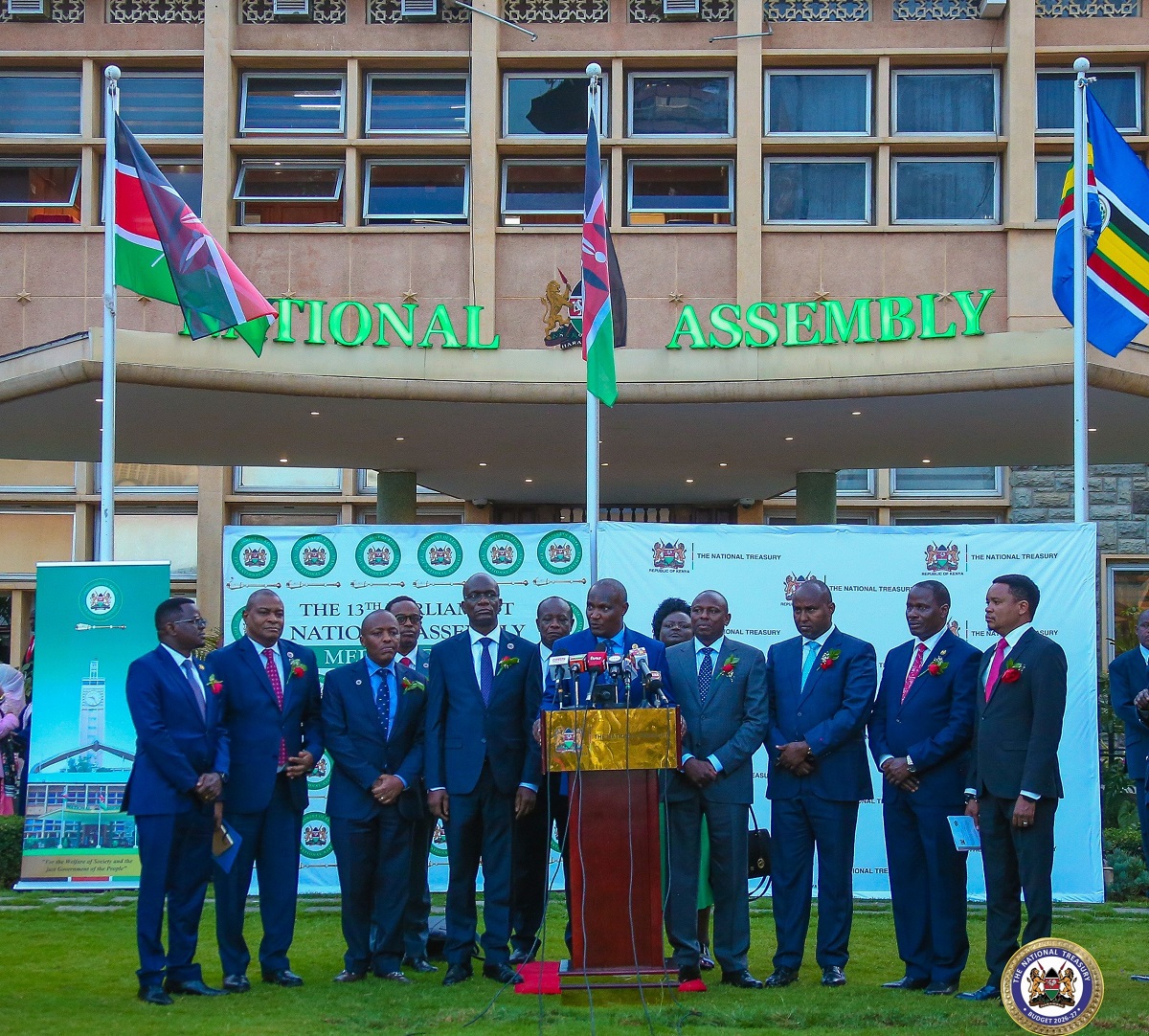
Kenya’s Treasury Cabinet Secretary John Mbadi presented a Sh4.82 trillion ($37.3 billion) budget to Parliament on Thursday that explicitly rules out new taxes on ordinary citizens, but leaves the East African economy walking a narrow fiscal tightrope between mounting debt service, a widening deficit and the urgent need to rev up growth amid global turmoil.
The 2026/27 budget, themed “Sustaining the Bottom-Up Economic Transformation Agenda for Resilient and Inclusive Growth amid Global Uncertainty,” projects a fiscal deficit including grants of Sh1.146 trillion, equivalent to 5.5 percent of GDP. That deficit will be financed through net external borrowing of Sh116.2 billion and net domestic borrowing of Sh1.03 trillion, a striking reliance on local debt markets that threatens to crowd out private sector credit.
Yet, the minister struck a defiantly populist tone, announcing that he had “deliberately chosen not to introduce new taxes or increase tax rates that would further overburden the hardworking Kenyans and their families.” Instead, the government is betting on administrative efficiency, base broadening, and targeted excise adjustments to raise an additional Sh98.9 billion in revenue.
The gamble comes exactly two years after deadly June 2024 protests forced the withdrawal of previous tax hikes, a political scar that clearly shaped this budget’s architecture.
Kenya’s FY2026/27 budget and the question of austerity
Total expenditure for 2026/27 is projected at Sh4.82 trillion (23.2 percent of GDP), of which recurrent expenditure accounts for Sh3.568 trillion (17.1 percent of GDP) and development expenditure just Sh750 billion (3.6 percent of GDP). The slender development envelope, less than one-sixth of total spending, underscores how debt service and wages are consuming the fiscal space needed for infrastructure and productive investment.
Mbadi was unusually candid about the bind. “Kenya’s infrastructure financing deficit stands at approximately $5 billion every year,” he told lawmakers. “Our development budget, while growing, cannot close that gap alone. The era of financing every road, every power line, and every dam through Government borrowing and taxation is over — not because we lack ambition, but because we have learnt from the consequences of that model.”
Debt-financed infrastructure has left Kenya with “more debt service obligations that crowd out the very spending our people need most: on health, education, and social protection,” Mbadi acknowledged. The government is now pivoting to Public-Private Partnerships and the newly established National Infrastructure Fund, seeded with Sh106.3 billion from the Kenya Pipeline Company IPO and an expected Sh204 billion from the partial divestiture of Safaricom to Vodacom.
Revenue shortfalls and supplementary shocks
The 2025/26 fiscal year has already required a supplementary budget that widened the deficit from an original 4.7 percent of GDP to 6.4 percent. Mbadi attributed the deterioration to slower-than-expected tax receipts, driven by “administrative constraints and a slowdown in economic activities,” alongside intensified expenditure pressures from newly negotiated collective bargaining agreements that raised the public sector wage bill beyond projections.
Emergency interventions for floods and drought have further squeezed fiscal space. The government has also allocated additional resources to the Kenya Revenue Authority for system upgrades and compliance enforcement, a tacit admission that voluntary tax collection is falling short.
Only 3.1 million working Kenyans currently contribute to Pay As You Earn, Mbadi revealed, while “millions of other Kenyans that make money in our economy do not contribute to the taxes we collect. Many of these people have been filing nil returns year after year. The burden of developing this country has therefore been on a few of us. This must change.”
Global headwinds and the need for domestic resilience
The budget was presented amid “heightened global uncertainty arising from the ongoing conflict in the Middle East,” which has disrupted global commodity markets and supply chains, weakened investor confidence, and tightened financial conditions. Global oil prices have surged from an average of $63.06 per barrel in February 2026 to $94.4 per barrel by end-May 2026, feeding directly into Kenya’s import bill and inflation.
Overall inflation rose to 6.7 percent in May 2026, up from 3.8 percent a year earlier, though it remains within the target range of 5 percent ± 2.5 percent. The Central Bank Rate has been cut from 11.25 percent in December 2024 to 8.75 percent, with commercial bank lending rates declining to 14.5 percent in May 2026 from 16.9 percent a year earlier. Private sector credit has expanded by 9.3 percent in the year to May 2026, a sharp recovery from the 2.0 percent growth recorded in May 2025 and a contraction of 1.4 percent in December 2024.
Yet the outlook for 2026 has been revised down to 5.0 percent from an earlier projection of 5.3 percent, reflecting the adverse impact of the Middle East conflict. The economy grew at an average rate of 5.0 percent between 2022 and 2025, outperforming global and Sub-Saharan African averages, but that resilience is being tested.
External buffers remain adequate but under pressure. Official foreign exchange reserves stood at $13.2 billion in May 2026, equivalent to 5.6 months of import cover. The exchange rate has averaged Sh129.4 per US dollar. However, the current account deficit is projected to widen to 3.0 percent of GDP in 2026 from 2.1 percent in 2025, driven by higher oil prices, lower receipts from services, slower remittance growth, and reduced exports.
Defence and security spending take up giant share of funding
One of the most revealing indicators of fiscal priority is security spending. Mbadi proposed Sh252.1 billion for Defence, Sh144.7 billion for the National Police Service, Sh64.1 billion for the National Intelligence Service, Sh63.9 billion for Internal Security and National Administration, and Sh42.6 billion for Prisons Services, a combined security allocation of approximately Sh567.4 billion.
By comparison, total development expenditure across the entire economy is Sh750 billion. The combined security budget is more than three-quarters of the entire development envelope. Specific security investments include Sh13 billion for leasing police motor vehicles, Sh7 billion for police modernisation, and Sh3.9 billion for stipends to village elders.
Health received Sh177.2 billion, education Sh784.5 billion largely to cater for teachers salaries and agriculture Sh64 billion. The Affordable Housing Programme received Sh143.7 billion across housing, urban development and public works sub-sectors.
Read also: Kenya doubles down on last-mile connections and mini-grids to achieve universal electricity by 2030
New tax measures target gamblers, scrap metal dealers
Kenya’s revenue package relies on a mix of administrative reforms, base broadening, and selective excise adjustments. Key proposals include:
· A minimum deemed dividend distribution threshold of 60 percent of undistributed income, targeting companies that indefinitely retain profits to defer dividend taxation;
· A new withholding tax on gambling winnings, lotteries and prize competitions;
· A 1.5 percent withholding tax on scrap metal sales;
· Removal of an exemption that allowed the national carrier to pay non-resident service providers without withholding tax while resident providers are taxed;
· A general anti-avoidance rule across all tax laws;
· A six-month tax amnesty starting July 1, 2026, covering penalties and interest on liabilities accrued up to December 31, 2025.
On consumption, Mbadi removed excise duty on bottled water and simplified mobile phone taxation by replacing multiple levies with a single 25 percent excise duty payable at network activation. Conversely, excise duty on sugar-sweetened beverages rises from Sh14.14 per litre to Sh20 per litre, and tobacco duties increase.
The government is also rationalising tax expenditures, which stood at Sh286.5 billion (1.8 percent of GDP) in 2024, down from Sh368.4 billion (2.4 percent of GDP) in 2023. VAT exemptions will be removed on denatured ethanol, affordable housing construction inputs, tourism facility inputs, and certain aircraft.
Read also: Kenya’s huge food deficit mask a deeper failure of finance, FSD Kenya reveals
Kenya’s growth on chokehold – FY2026/27 budget numbers show
Despite the fiscal squeeze, Mbadi insisted that Kenya cannot afford to choke off growth. The economy is projected to grow at 5.2 percent in 2027, but that forecast assumes a de-escalation of the Middle East conflict, an assumption that looks increasingly fragile.
The government is leaning heavily on private capital mobilisation through PPPs, targeting at least Sh70 billion in private investment in 2026/27 across energy, transport, water, housing, health, and digital infrastructure. Priority projects include the High Grand Falls Hydropower Project (700MW), the Karura Hydropower Project (90MW), and the Rironi-Nakuru-Mau Summit Expressway, which is being financed with domestic capital from the National Social Security Fund.
“Kenya is not just open for business, Kenya is investing in itself,” Mbadi said, while also calling on European manufacturers to “stop extracting raw materials and instead invest in local value addition” a line that drew the only applause of the afternoon.
Read also: Gen Z behavioral traits that brands, media need to know
Economic shocks in the horizon
What emerges is a budget of contradictions: no new taxes on households, yet deeper reliance on domestic borrowing that could push up interest rates for the same households. Ambitious infrastructure ambitions, yet a development budget dwarfed by recurrent spending. A pledge to protect the vulnerable, yet a security budget that exceeds total development expenditure.
Mbadi acknowledged the tension directly. “Fiscal policy is not merely about balancing the budget,” he said. “It is about creating conditions for sustainable growth, protecting the vulnerable, and securing prosperity for future generations.”
Whether this narrow path is walkable will depend on three variables beyond the Treasury’s control: the price of oil, the course of the Middle East conflict, and whether Kenya’s tax amnesty and efficiency drive actually deliver the Sh98.9 billion in additional revenue without triggering the kind of street protests that sank last year’s finance bill.
For now, Mbadi has bought time — and political breathing room — by leaving the average Kenyan’s tax bill unchanged. But the country’s creditors, both foreign and domestic, will be watching the deficit closely.
(1 USD = Sh129)