

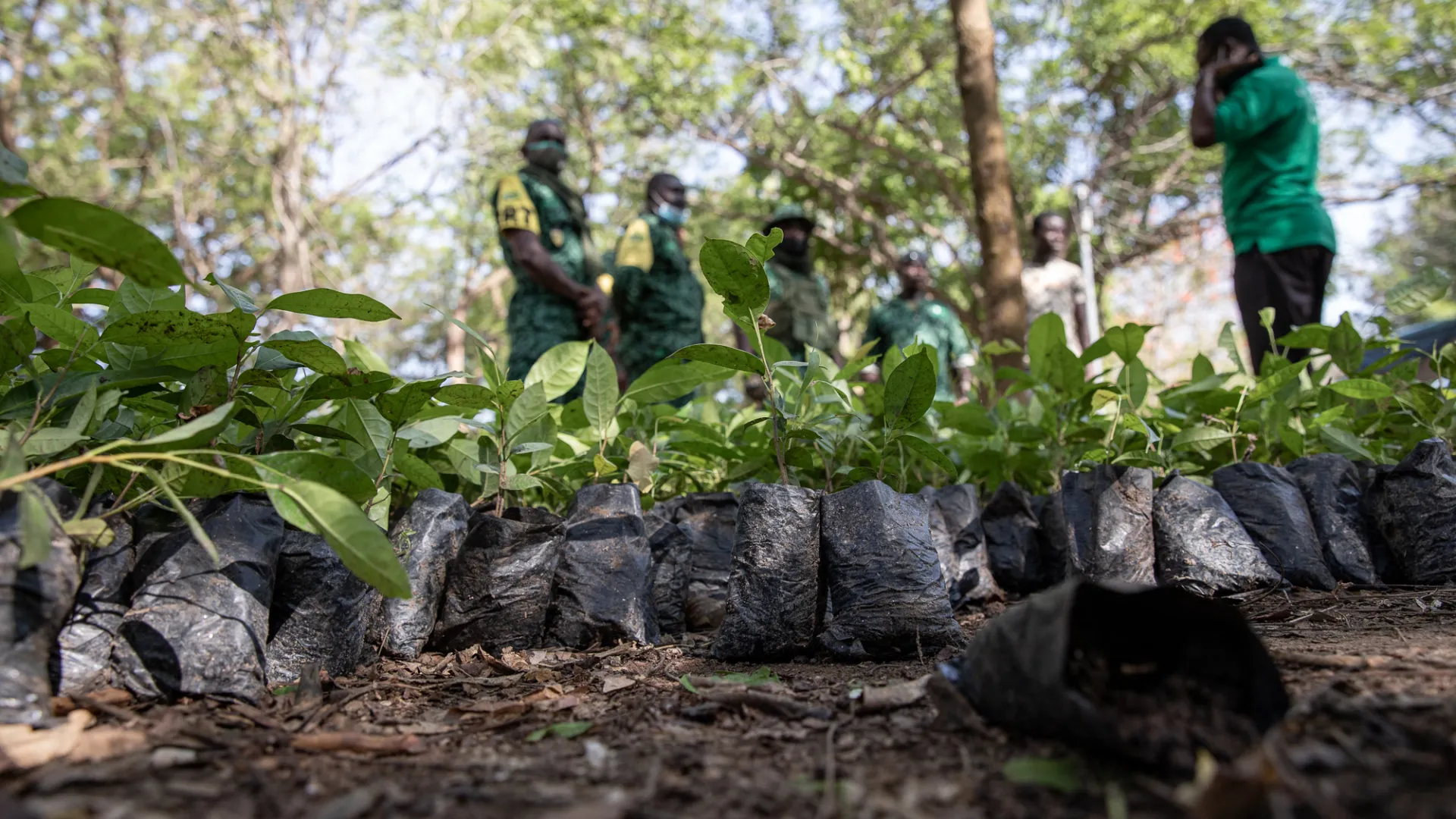
- Ghana offers free seedlings nationwide to shore up tree planting in the latest push to tackle climate chnage.
- Ghana reports $260 million earned in 2025 from forestry.
- UNEP commends climate financing commitments, calls for decisive action.
Ghana has introduced a free seedlings disbursement initiative across the country in a renewed drive to curb deforestation and restore affected areas, offering a blueprint that could be rolled out in the rest of the continent. Forestry and forest products offer huge green investment opportunities for Africa but also threaten energy transition ambitions, and finding the balance is a tough call for policymakers.
According to Ghana’s CEO of the Forestry Commission (CEO), Hugh Brown, the country earned in excess of $260 million from timber and timber product exports and domestic sales in 2025. Accra’s total volume of 952,000 cubic metres of timber and timber products and ecotourism attracted over 800,000 visitors, representing an increase of more than 20 percent over the previous year.
Brown was speaking at the launch of the 2026 edition of the Tree for Life (T4L) Reforestation Initiative, held during the World Environment Day celebrations. Held under the global theme: ‘Inspired by Nature, For Climate for Our Future,’ and the Tree for Life theme: ‘Forests and Economies,’ the World Environment Day celebrations brought to light both challenges and opportunities in Africa’s forestry sector.
In Ghana, more than 20 percent of the country’s population depends directly on forest resources for their livelihoods, food security and healthcare needs. Ghana’s forest cover is estimated at 6.4 million hectares, representing about 27 percent of the country’s land area, with 1.02 million hectares classified as closed-canopy forest and 5.37 million hectares as open forest.
“While forests play a vital role in sustaining the country’s cocoa industry through the provision of favourable microclimatic conditions, and important watersheds for major rivers, unchecked activities threaten sustainability,” Brown cautioned.
To date, the forestry sector in Ghana employs close to one million people in logging, timber processing, furniture manufacturing, plantation development, ecotourism, herbal medicine practice and forest management, Brown pointed out.
“Despite these benefits, deforestation and forest degradation, particularly within the high forest zone, continue to endanger biodiversity, wildlife habitats and the livelihoods of forest-dependent communities,” Brown decried.
To curb the trend, the CEO said achievements under the 2025 Tree for Life Initiative, a total of 23,600 hectares of degraded and deforested lands have been restored through enrichment planting and plantation development.
According to Brown, 1.9 million seedlings have been planted under the amenity planting programme, and 2.1 million seedlings nurseries have been started under the Trees-on-Farm component.
“In total, about 30.8 million tree seedlings were planted across the country by the Forestry Commission, private sector organisations and civil society groups,” he detailed.
The official also pointed out that recent survival assessment shows encouraging results, with seedling survival rates ranging between 65 percent and 85 percent in the high forest zone and between 40 percent and 78 percent in the northern savannah ecological zone.
“For the 2026 planting season,” he said “…the Forestry Commission, in collaboration with private sector partners and other stakeholders, aim to plant 30 million seedlings nationwide.”
To achieve this goal, Ghanaian officials are offering free seedlings to all citizens through the Forestry Commission offices across the country.
Further still, the Commission is conducting a review of the Forestry Commission Act, plans to introduce payment-for-ecosystem-services schemes, and enhancing ecotourism investments along with intensifying training for forestry frontline staff.
Also Read: Tanzania eyes Belarusian tractor model and motor pools to unlock untapped farmland
Azerbaijan launches national tree planting initiative, cites two regions for zero-emission
Ghana’s national tree planting initiative follows a similar drive adopted halfway across the planet in Azerbaijan. Notably, the World Environment Day celebrations were globally commemorated on 5 June 2026, in Baku, the Republic of Azerbaijan.
UNEP commends the country’s significant strides in protecting its natural heritage with over 10 percent of the country’s territory now under protection.
Delegates at the event were cautioned; “The planet doesn’t argue. It doesn’t negotiate. It sends signals, rising seas, raging wildfires, heat waves, melting glaciers. We said 1.5°C was the limit. We are crossing it,” UNEP said in a press release following the World Environment Day celebrations.
Led by UNEP, delegates were cautioned that for decades now, the climate change warnings, targets and deadlines have been clouded by delay, distraction and denial.
“The UNEP global campaign calls on all of us to step in, to move further, to steer a world already in motion. The question is no longer if change comes, but how we guide it and how fast it happens,” reads the statement in part.
However, UNEP also recognized achievements made; “Solar panels stretch across rooftops, wind turbines line the horizon, cities are being redesigned for sustainability and forests are being replanted…positive tipping points are taking root in every corner of the planet.”
According to UNEP, as part of its Paris Agreement Party, Azerbaijan has committed to reducing emissions by 40 percent by 2035. “Azerbaijan is also pursuing green growth and renewable energy at pace and ams to increase renewable energy to 30 percent by 2030,” UNEP details.
The country is also conducting large-scale green projects including set up of the 230 MW Garadagh Solar Plant and the 240 MW Khizi–Absheron Wind Farm.
“Urban sustainability is advancing in Baku with modern low- and zero-emission buses, EV infrastructure, and smart city solutions are been adopted,” details the UNEP.
Another notable green initiative in Azerbaijan is the transformation of its Garabagh and East Zangezur regions into zero-emissions zones. In both these regions, Azerbaijan is adopting a mix of renewable energy and ecosystem restoration initiatives. Similarly, the country has introduced modernized water management and climate-resilient agriculture to strengthen adaptation in it’s drought prone areas.
Azerbaijan has also launched new legislative reforms prohibiting the import, production, as well as sale or provision to consumers of single-use plastics and polyethylene bags with a thickness of up to 15 microns.
As the host of COP29 global climate talks Azerbaijan secured landmark decisions on climate finance and carbon markets. According to UNEP, the COP29 achievements include developed countries committing to an annual target of $300 billion by 2035.
“A broader aspiration was established to scale up total climate investments from all public and private sources to $1.3 trillion per year by 2035,” UNEP notes.
Another groundbreaking achievement is the Loss and Damage Fund which UNEP says officially reached agreements with the World Bank allowing it to start distributing funds. “Pledges for this fund now exceed $730 million to aid vulnerable nations recovering from climate disasters,” UNEP said.
Notably, Azerbaijan will host the 13th session of the World Urban Forum (WUF13) that will be held in partnership with UN-Habitat and is expected to result in green cities global initiatives that will include tree planting drives as part of global modern green city designs.
Read also: Africa reminds COP30 that forests fight hunger, poverty, and extinction all at once