


- Global actors race to fund Africa’s digital connectivity as the new investment frontier.
- Blue-Raman undersea cable to lower internet prices across EAC.
- Improved connectivity bridges Africa’s to next phase of development.
The European Union has committed $42.8 million to extend Google’s Blue-Raman undersea cable into East Africa, Kenya’s President William Ruto has announced.
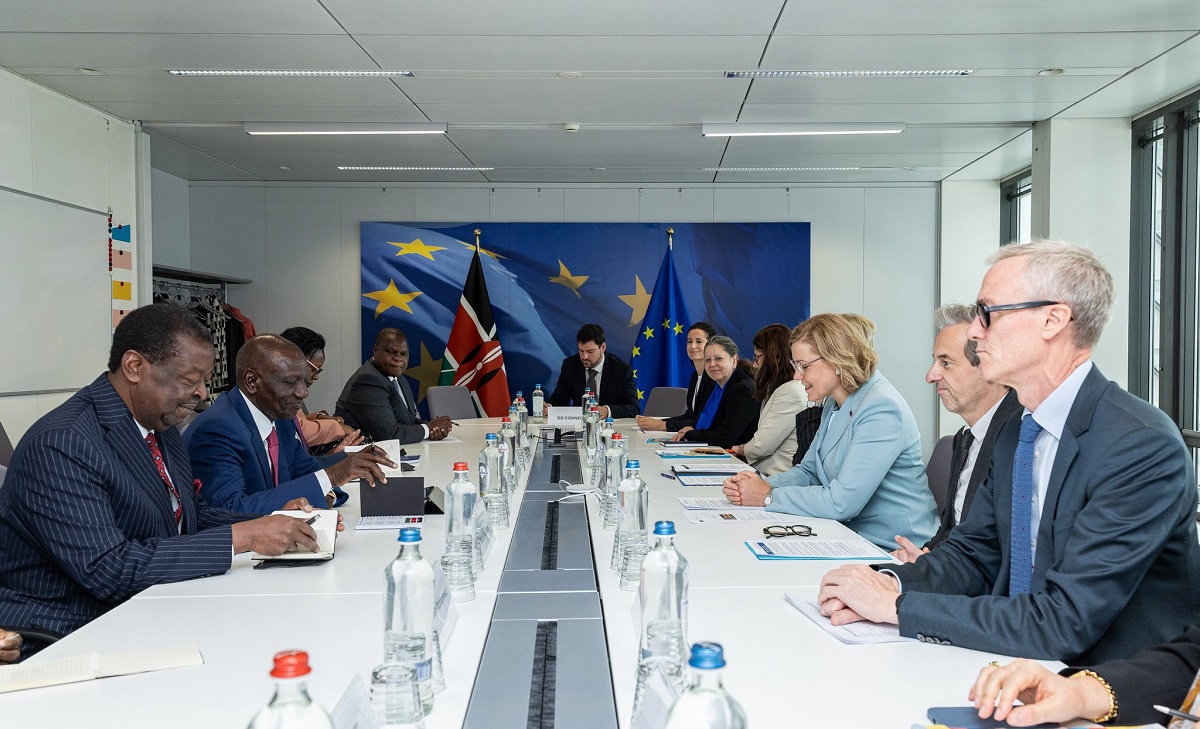
Speaking following talks with European Commission Executive Vice-President Henna Virkkunen in Brussels, Kenya’s President William Ruto said the extension of Google’s Blue-Raman the cable will improve internet connectivity, reduce bandwidth costs and strengthen the EAC digital economy.
Ruto said the cable extension will connect Kenya, Tanzania, Somalia and Djibouti to Google’s Europe, Middle East and India digital corridor. “The investment forms part of a broader push to strengthen Africa’s digital infrastructure and support future growth in cloud computing, AI and digital trade,” President Ruto explained.
The Blue-Raman system is a subsea network of digital cables that was unveiled in 2021 backed by Google and Sparkle, an Italian telecommunications company among several other operators. It contains 16 fibre pairs (Blue and Raman) and runs on an open-access model designed specifically to increase competition among internet providers.
It is so far made up of 12,700-kilometre of under sea cable network that connects Europe and India through the Middle East and offers a new route for international internet traffic. Divided into two sections, the Blue segment links Italy, France, Greece and Israel, while the Raman segment connects Jordan, Saudi Arabia, Djibouti, Oman and India markets.
Now, with EU funding, the cable will be extended into East Africa giving the region direct access to one of the newest high-capacity international data routes. It is also expected to lower internet prices as EAC governments look to increase internet access, support digital trade and meet the growing demand for cloud computing and artificial intelligence services.
The European Union funding is part of its larger EU-Africa-India Digital Corridor initiative and its Global Gateway programme that is meant to strengthen digital connectivity between Europe, Africa and Asia. The investment is timely as the East Africa Community (EAC) experiences rapid growth in digital services, mobile money, e-commerce and online business outsourcing.
As the EAC expands its digital presence, Kenya stands as one of Africa’s leading technology hubs. President Ruto said the Blue-Raman cable will lower bandwidth costs across the region, since increased international connectivity leads to cheaper internet services.
Backing Dr. Ruto’s point, a 2025 report by the Foundation for Studies and Research on International Development asserts that “doubling international connectivity capacity can significantly reduce both mobile and fixed broadband prices.”
The President said lowering internet costs in the EAC will be a game changer both for businesses and individuals. Today, broadband affordability in the EAC remains far behind international targets despite years of investment in digital infrastructure.
“Lowering connectivity costs will help East Africa to attract investment by data centres, cloud service providers and technology companies that require reliable international connectivity to operate efficiently,” president Ruto told stakeholders.
Also Read: Tanzania and Russia agree on $2 billion worth of investments at SPIEF
Will Blue-Raman undersea cable overcome PEACE, SEACOM failures?
Analysts are optimistic that the Google supported Blue-Raman cable will not suffer disruptions that it’s predecessors have succumbed to. Recently, there have been transmission failures by major digital cables that run along the EAC coastline causing widespread internet disruptions.
Most recently was the March 2025 damage to the PEACE cable which affected internet traffic across Africa and Asia. Before that, the EASSy and SEACOM systems also suffered connectivity failures across several East African countries.
These occurrences underscored the risks of depending on a limited number of international connectivity routes making the new cable a much welcome announcement for all stakeholders in the region. Further still, analysts say additional cable systems are necessary as the EAC is experiencing internet traffic surges due to cloud computing, video streaming and emerging artificial intelligence applications.
Blue-Raman project serves to provide an alternative route that will help reduce reliance on congested digital networks allowing for faster and smoother transfer of data. “Efficiency in data transmission is an increasingly important consideration amid geopolitical tensions and security concerns affecting international telecommunications infrastructure.”
Read also: AI-first telcos will lead the race in Africa
EU funded data cable to improve digital security?
The European Union’s broader effort to expand its presence in Africa’s digital infrastructure sector. Notably, the EU is increasingly focusing on financing strategic EAC projects and digital connectivity is a key frontier as competition intensifies among global powers looking to command influence in Africa’s next phase of economic development.
African economies are increasingly becoming data-driven, hense control over digital highways is becoming a strategic area of investment for global partners just like ports, roads and power networks. Likewise, for East Africa, the Blue-Raman extension supports it’s ambitions to build the necessary digital infrastructure needed to support growth in fintech, artificial intelligence, cloud services and cross-border digital trade.
“This project contributes to the development of a 11,700 km long trusted and secure intercontinental submarine cable system, stretching from Europe to India with intermediate landings in the Mediterranean, Middle East and Eastern Africa,” says the WU in it’s official report on the funding commitment.
The report, published under it’s June review of the Global Gateway Programme, the report says; “The EU intervention will provide ultra-high speed diversified data connectivity on the Blue-Raman cable to connect India, Southeast Africa (via Djibouti) and Europe, enabling secure, best-in-class and future-proof connectivity for the exclusive use of research and education institutions.”
Overall, the Global Gateway Programme is meant to enhance global collaboration and innovation. It is designed to reach some 10,000 academic and research institutions across Europe and host an estimated 50 million researchers and students, and their counterparts in around 1850 institutions in India and 1900 institutions in Southeast Africa.
“The capacity will serve future demand including for potential extensions to South Asia and Eastern Africa with significant benefits for bridging the digital divide,” details the EU programme review report.
The report also says, while the programme is EU funded, it is co-developed with Géant, a European data network provider that focuses on connectivity for research and education institutions as well as several counterparts in India, and Eastern and Southern Africa.
Read also: AI Everything Kenya x Gitex Kenya stirs Nairobi as East Africa embraces new AI blueprint