


- Tanzania-Russia partnership is on the verge of a new era after President Samia Suluhu, who’s facing increasing isolation from the West, woos foreign investment at St. Petersburg International Economic Forum.
- In the latest edition of this global forum, Tanzania and Russia agree on over $2 billion worth of investments.
- Key projects include development of economic zones, Rostum uranium, Roscongress Foundation tourism investment.
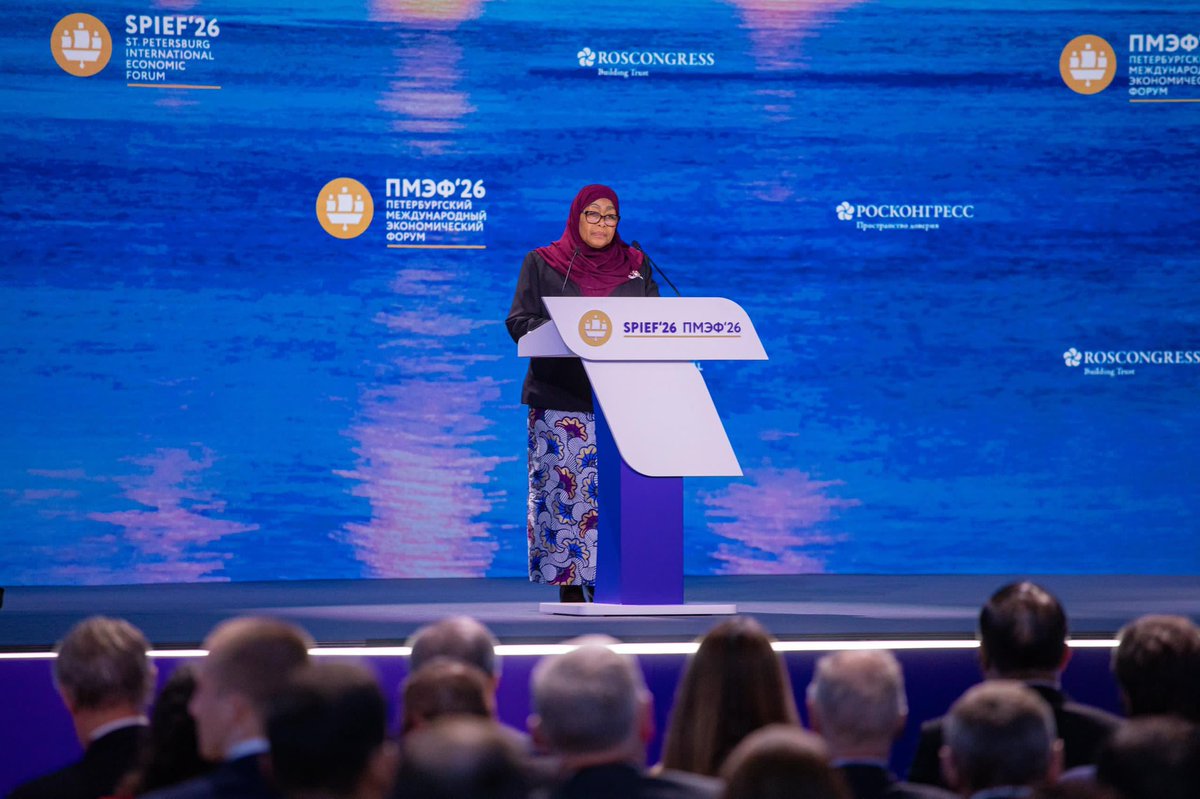
Tanzania and Russia have entered several investment agreements at the just ended St. Petersburg International Economic Forum (SPIEF). The high-level forum attracted more than 24,000 participants from over 140 countries, including heads of state, investors and executives from world leading companies representing various economic sectors.
Hosted by Russia’s President Vladimir Putin, Tanzania President Samia Suluhu Hassan placed annual bilateral trade between the two nations at over $300 million. She noted that both nations have agreed on strategic ambitions to double the said trade value come 2030.
President Samia pitched five key priority areas leading with investment in the development of Special Economic Zones. Key priority development sectors highlighted by the president include mining and mineral value addition beyond the traditional extraction and export.
Agriculture mechanisation and related value chain industrialization was another area the president zeroed in. She particularly called for investment in potential domestic fertilizer production.
Dr. Suluhu reassured investors that Tanzania is open for business and aims to ‘become one of Africa’s leading investment destinations.’ She said Russia’s investment (and other foreign entities) would help the country develop it’s ports and speed up rise of manufacturing industries both been key areas of economic growth and job creation.
The outcome of the president’s pitch is an expected $2 billion financing from Russia. Another key achievement of Tanzania’s participation at SPIEF includes a deal signed with Russia’s Roscongress Foundation to boost tourism and infrastructure investments.
The Roscongress Foundation is behind Air Tanzania, the country’s flag bearer, launching direct flights connecting Dar es Salaam, Zanzibar, and Moscow. Notably, Roscongress and Tanzania have previously hosted major B2B events, including the Tanzania-Russia Business and Investment Forum that was held in Arusha that has so far help attract Foreign Direct Investment (FDI) in the local tourism and hospitality sector.
The foundation also co-organizes high-profile events to boost Tanzania’s tourism including the ‘Let’s Travel!’ International Tourism Forum in Russia. Commitment was also made to the ongoing uranium exploration led by Russia’s ROSATOM.
Last year, the two countries launched a pilot uranium processing plant commissioned by Rosatom subsidiary Mantra Tanzania Ltd at the Mkuju River project in southern Tanzania. Located at the Nyota deposit, the plant serves to test uranium processing technologies that will be the blueprint of the main processing complex with a production capacity of up to 3,000 tonnes of uranium per year.
At the commissioning ceremony, Dr. Samia said; “This is a landmark achievement for our country. For the first time, Tanzania is stepping onto the global uranium map with the capacity to supply a strategic mineral that is essential for safe and sustainable energy generation worldwide.”
Seconding the president, Tanzania’s Ministry of Minerals lauds the plant as a “strategic project set to transform the country’s mining and energy landscape and open new doors for foreign investment, clean energy solutions and high-value technological advancements.”
Data shows that Tanzania holds a 20 percent stake in the project which is expected to earn the country $40 million annually in dividends. “Tanzania will enter the list of the top 10 uranium-producing nations,” the president projected.
In his remarks, Alexey Likhachev, Rosatom Director General, said, “Rosatom is always guided by the principles of sustainable development with unconditional compliance with high environmental and social standards. We will be happy to help Tanzania take an important step towards integration into the global nuclear energy industry.”
Read also: Russia Opens a New Trade Frontier in Africa
Tanzania-Russia partnership in Bagamoyo Special Economic Zone
Further, Dr. Samia singled out the Bagamoyo Special Economic Zone (BSEZ) as a flagship project that offers significant opportunities for global investors. “The Bagamoyo Special Economic Zone is our number one project, and we welcome international companies to partner with us in its development,” she said.
The Bagamoyo Special Economic Zone project, located on the Indian Ocean coastline is designed to serve as a major hub for manufacturing, logistics, and trade. “Its strategic position makes it particularly attractive for companies looking to access both regional and international markets, especially those targeting the growing East African Community economic bloc,” Dr. Samia reassured stakeholders.
The economic zone is valued at $10 billion, the megaproject is envisioned to transform Tanzania into a regional transport, logistics, and manufacturing hub.
Covering 9,000 hectares, the Bagamoyo Special Economic Zone includes a massive deep-sea port at Mbegani that is meant to serve as the primary gateway for international trade that will relieve congestion at the Port of Dar es Salaam. It also features an industrial park that covers 151 hectare with some 134 designated industrial plots meant to house textiles, pharmaceuticals, automotive, and regional offices.
The Tanzania Standard Gauge Railway (SGR), links it to the country’s central and regional transport networks guaranteeing flawless movement of good. The project is under the Tanzania Investment and Special Economic Zones Authority (TISEZA) which requires a minimum capital commitment of at least $10 million and at least 20% Tanzanian ownership of all projects within the zone to guarantee local content.
In her closing statement, President Dr. Samia said her government is committed to creating a conducive business environment that welcomes foreign investment participation across all sectors with special emphasis on local content opportunities and going green.
Read also: Russia’s Rosatom inks $1.2 Billion nuclear energy deal with Tanzania