



- Dangote Refinery’s transaction is poised to have cross-listings in five African exchanges, setting a template for continental capital market integration.
- Success hinges on transparent pricing, currency stability, and regulatory execution.
- The IPO would fund capacity expansion to 1.4m bpd, challenging European and Middle Eastern refiners in Africa’s fuels market.
Dangote Refinery is mulling a grand undertaking by raising $5 billion through a Pan-African Initial Public Offering (IPO), a deal that is poised to raise the bar for capital markets across the continent. Analysist observe that the initiative is set to involve at least six stock exchanges across Africa, possibly involving Abidjan, Nairobi, Johannesburg besides Nigeria’s Lagos bourse.
If successful, the offering, valued by analysts at up to $5 billion from a 5-10 per cent stake, implying a $40-50 billion enterprise value, would be the largest ever IPO in sub-Saharan Africa outside of mining giant Anglo American’s secondary listings.
More importantly, it would be the first genuine test of whether the African Continental Free Trade Area (AfCFTA) can transform capital markets as well as goods. Yet for all the fanfare, the Dangote IPO is also a high-wire act, vulnerable to Nigeria’s volatile naira, opaque crude pricing, and the skepticism of global institutional investors burned before by African energy mega-projects.
The Exchange set out to dissect the mechanics, ambitions, and risks of what Dangote’s advisers have internally codenamed “Project Unify”, drawing on credible reports, announcements, and market updates.
Why Dangote Refinery Demands a Pan-African Listing Now
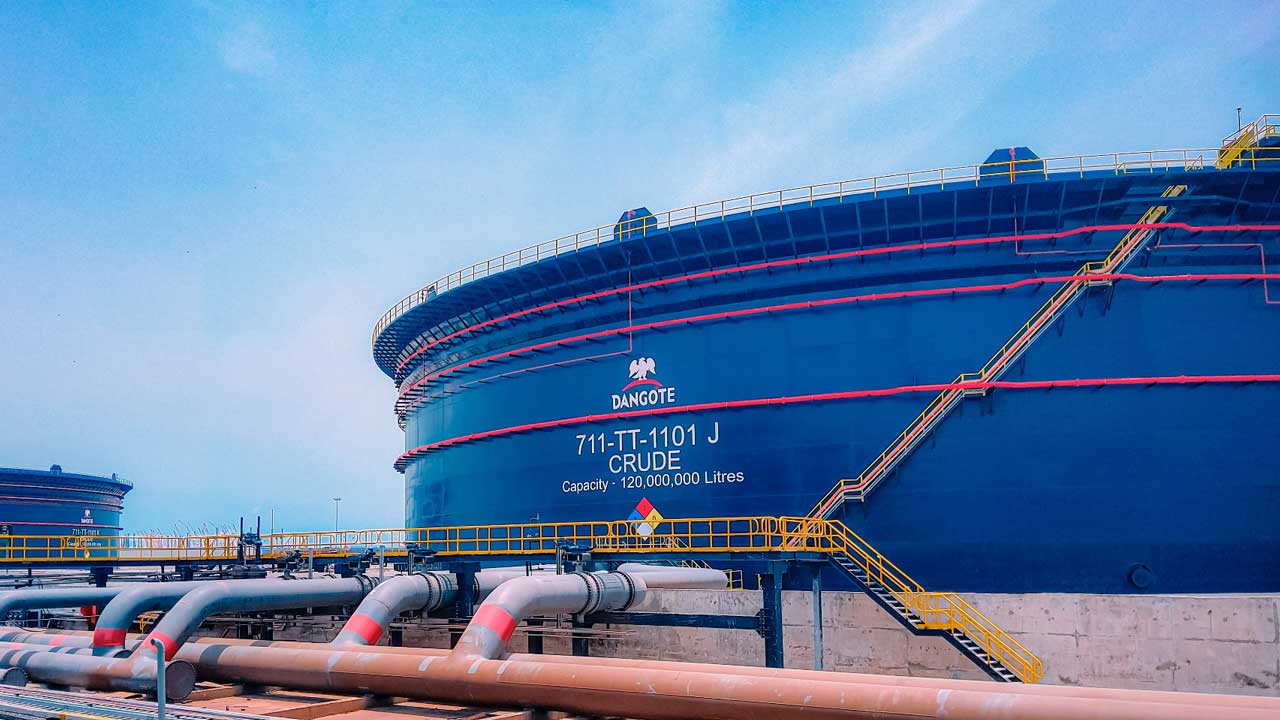
To understand the IPO’s significance, one must first appreciate the asset’s scale. The Dangote Petroleum Refinery is not merely Africa’s largest, it is the world’s largest single-train facility, meaning all 650,000 barrels flow through an integrated complex rather than split across multiple units. This design confers operational efficiency but also concentrated risk: a single fire or technical fault could shut down a substantial chunk of Nigeria’s domestic refining capacity.
Strategically, the refinery is already reshaping regional energy flows. Before its start-up, Nigeria, Africa’s biggest oil producer, imported nearly 90 per cent of its refined fuels, a paradox that drained $10 billion annually in foreign exchange.
Dangote now supplies petrol, diesel, aviation fuel, and polypropylene to the local market and has started exporting to West African neighbours, with plans to reach European markets. According to a company presentation seen by The Exchange, the refinery generated $6.4 billion in export revenues in its first nine months of operation, primarily from fertilisers (urea) and petrochemicals.
The IPO prospectus, slated for submission this month (April 2026) to Nigeria’s Securities and Exchange Commission, will reveal unit economics that Dangote Group has so far guarded jealously.
Analysts at Lagos-based Vetiva Capital estimate the refinery’s gross refining margin at $12-15 per barrel, competitive with India’s Reliance Industries’ Jamnagar complex but below top-tier Middle Eastern operators.
A $22 billion offering of 5-10% equity, implying a $44 billion valuation at the midpoint, would represent a 7-8x multiple on projected 2025 EBITDA of roughly $5.5 billion. That is a premium to many European refiners but a discount to integrated majors such as TotalEnergies.
“The valuation is ambitious but defensible if they can prove consistent utilisation above 90 per cent,” says Funke Adeyemi, head of energy research at Nairobi-based AIB Capital. “The real novelty is the listing strategy. No African company has attempted a simultaneous primary listing in Nigeria and secondary listings in South Africa, Kenya, Ghana, Ethiopia, and the BRVM [Bourse Régionale des Valeurs Mobilières, the West African regional exchange].”
The Mechanics: A Multi-Exchange Roadshow
The timeline, as outlined after an April 1 meeting in Lagos between Dangote, his advisers (widely reported to include Citigroup, Standard Bank, and Nigeria’s Chapel Hill Denham), and representatives of the six target exchanges, is aggressive:
– April 2026: Prospectus submission to Nigerian Exchange (NGX) Group.
– May 2026: Investor roadshow spanning Lagos, Johannesburg, Nairobi, Casablanca, London, and Dubai.
– June/July 2026: Primary listing on NGX, followed within weeks by secondary listings or depository receipt programmes on the Johannesburg Stock Exchange (JSE), Nairobi Securities Exchange (NSE), Ghana Stock Exchange (GSE), Ethiopian Securities Exchange (ESX — which only opened in late 2024), and the BRVM.
Dangote Group sees the IPO as a way to lock in local institutional investors, pension funds, sovereign wealth funds, and asset managers, across the continent, reducing reliance on fickle foreign portfolio flows.
Under the AfCFTA’s financial services protocol, cross-border listings are supposed to gain preferential treatment, though implementation remains patchy. Ethiopia’s ESX, for instance, has yet to finalise rules for foreign ownership, while Kenya’s NSE requires a local trustee for any depository receipt programme.
“A pan-African IPO of this scale would force regulators to harmonise disclosure standards, settlement cycles, and investor protection rules,” states Mame Fatou Diagne, a Dakar-based capital markets consultant. “That is a heavy lift, but Dangote’s leverage is immense. No exchange wants to be left out of the continent’s biggest-ever listing.”
For Dangote Refinery, the roadshow will be pivotal. Nigerian institutional investors, flush with naira-denominated assets after the central bank’s 2024 reforms, are expected to anchor the deal.
South Africa’s pension giants, PIC and GEPF, have signalled interest, but demand from Kenya and Ghana may be softer given smaller pools of domestic capital. The BRVM, covering eight West African nations, offers a combined market capitalisation of just $70 billion, so its role will likely be symbolic.
Risks: Oil Prices, Naira Volatility, and Governance
No IPO of this magnitude is without pitfalls. And for Dangote Refinery, three stand out.
First, oil price and margin compression. The refinery’s profitability depends on the crack spread, the difference between crude input costs and refined product prices. In 2024, that spread averaged $13/bbl, supporting Dangote’s exports.
But if global oil demand softens (as the IEA projects for late 2025) or if Chinese and Indian refiners dump surplus diesel into Africa, margins could shrink to $8/bbl or less. The prospectus will need to show stress-tested scenarios, including a floor price for Nigerian crude (the refinery processes mostly local Bonny Light and Forcados grades).
Second, naira volatility. Nigeria’s currency has stabilised somewhat since the central bank floated the naira in mid-2024, trading at around ₦1,450/$. However, the refinery incurs dollar-denominated costs (crude, catalysts, maintenance spares) but sells fuel domestically in naira at regulated prices, a mismatch that previously forced Dangote to import dollar loans.
The IPO’s $5 billion proceeds, if raised in dollars via a global depositary receipt structure, would partly hedge that risk. But a sharp naira depreciation would still hammer local-currency earnings for Nigerian shareholders.
Third, governance and transparency. The Dangote Group remains a family-dominated conglomerate. While the refinery’s CEO, Devakumar Edwin, is a respected industry veteran, the board includes close associates of Aliko Dangote.
International investors will demand independent directors, an audit committee with real powers, and quarterly public disclosures, all unusual for Nigerian family firms. The IPO prospectus must also clarify related-party transactions: for instance, does the refinery buy crude from Dangote’s upstream assets at market or preferential rates?
A further, often-overlooked risk is political. The Nigerian government is a 20 percent equity holder in the refinery after a 2023 debt-for-equity swap, though those shares are held by the state-owned NNPC.
A change in administration after 2027 elections could revisit that arrangement, especially if populist politicians decry Dangote’s “monopoly” over domestic fuel pricing. Already, the Nigerian Midstream and Downstream Petroleum Regulatory Authority has signalled plans to cap Dangote’s export volumes to guarantee local supply, a move that would cap dollar revenues.
The AfCFTA Moment: Capital Markets Integration
For proponents of the AfCFTA, the Dangote IPO is a laboratory for financial integration. The agreement, which became operational in 2021, has so far focused on tariff reduction and customs cooperation.
Its protocol on investment and financial services, however, envisions mutual recognition of stock exchange listings, harmonised prospectus rules, and cross-border clearing. In theory, a company listed on the NGX should be able to raise capital in Accra or Abidjan without duplicative regulatory approvals.
In practice, that ideal remains distant. Each target exchange maintains its own listing rules. South Africa’s JSE requires a minimum free float of 20 per cent, far above the 5-10 per cent Dangote plans. The compromise, according to a source close to the talks, is that secondary listings will be via depository receipts (DRs), not direct shares, allowing the JSE to waive its free-float rule. Ethiopia’s ESX, still building its settlement system, may only offer a “notional” trading facility initially.
Even with these workarounds, the signal matters. “If Dangote succeeds, every large African conglomerate, from MTN to Equity Bank to OCP, will revisit pan-African listings,” says Yofi Grant, former CEO of the Ghana Investment Promotion Centre. “It could unlock a wave of cross-border equity issuance, deepening liquidity on smaller exchanges.”
Conversely, failure would set back the cause by a decade. A botched IPO, whether from poor investor demand, regulatory squabbles, or post-listing governance scandals, would reinforce the view that African capital markets are too fragmented for multi-jurisdictional offerings.
Strategic Implications for Global Oil Majors
Western oil companies are watching closely. For decades, Shell, TotalEnergies, and Eni have operated African refineries as captive units of their integrated supply chains. They have largely avoided large-scale new refining capacity in sub-Saharan Africa, preferring to ship products from European and Middle Eastern plants. Dangote’s success, or struggle, could inform their future investment decisions.
If the IPO raises $5 billion and the refinery expands to 1.4 million bpd within three years (as Dangote has stated as a goal), the plant would become the third-largest globally, after only India’s Jamnagar and Venezuela’s Paraguana Refinery Complex.
That scale would give Dangote pricing power over fuel imports into West and Central Africa, undercutting European refiners on freight costs alone. TotalEnergies’ 210,000-bpd Satorp refinery in Saudi Arabia, a joint venture with Aramco, would face a formidable rival in African markets.
However, global majors also see opportunity. Several have approached Dangote about offtake agreements or equity stakes. A successful IPO would set a valuation benchmark, making it easier for Shell or Eni to negotiate a minority investment. Conversely, a flop could force Dangote to seek a strategic investor at a discount, a scenario that would please the majors.
A Milestone in Search of Execution
There is no precedent for what Dangote is attempting. The world’s largest single-train refinery, owned by Africa’s richest man, going public simultaneously on half a dozen African exchanges, it is either visionary or hubristic.
The numbers are plausible: a $40-50 billion valuation, $5 billion raised, 1.4 million bpd capacity within three years, $6.4 billion in annual exports already achieved. But numbers alone do not persuade global investors.
What matters is execution. Can Dangote’s team produce quarterly accounts audited to international standards? Can Nigeria’s regulators process a prospectus of this complexity within weeks, not months? Will the naira remain stable enough for local-currency investors to see real returns? And can the AfCFTA’s financial protocol move from aspirational text to operational reality?
Aliko Dangote, now 68, has spoken of this IPO as his legacy project, indication that an African industrialist can build and then publicly list a world-class asset without selling control to Western private equity. On paper, it is exactly the kind of transaction that African capital markets need: large, transparent, cross-border, and linked to a real economy asset. In practice, it remains a high-stakes gamble. The roadshow begins in May. By July, we will know whether Dangote has written a new chapter in African finance, or a cautionary tale.
Read also: Afreximbank leads $4 billion Dangote Refinery refinance plan