

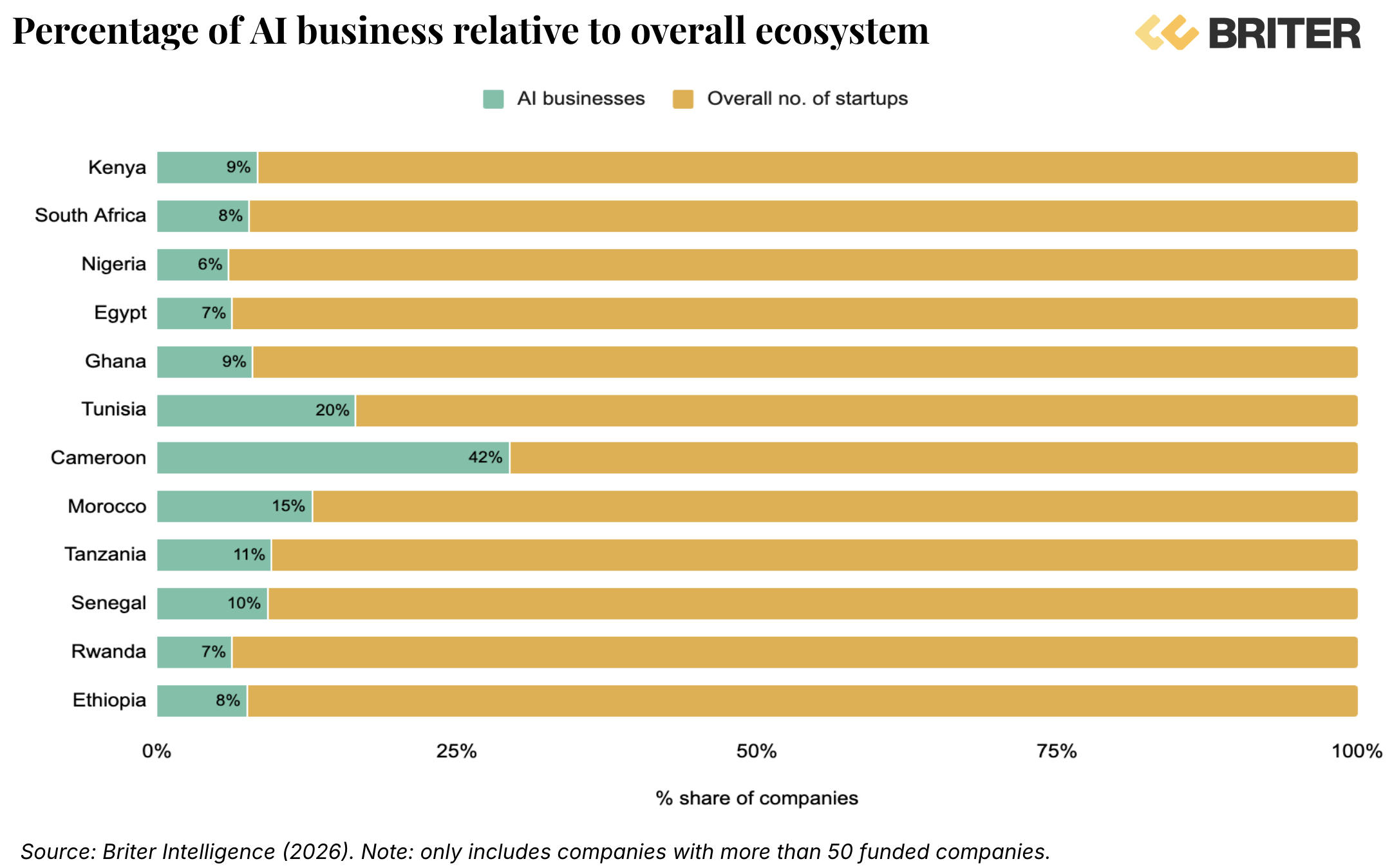
- AI economy in Africa is fast evolving. Fresh data shows that while Nigerian and Kenyan firms are busy layering AI onto fintech or logistics platforms, Tunisia and Cameroon are showing greater concentration of AI businesses.
- From agriculture to health, Africa’s AI ecosystem is shifting from merely adopting foreign technology to building its own. Currently, there are nearly 300 AI businesses operating in different sectors of the economy in Africa.
The narrative surrounding artificial intelligence (AI) in Africa has long been dominated by discussions of potential, of leapfrogging, and of the risk of the continent being left behind.
However, a new data-driven analysis from emerging markets tracker Briter Bridges, combined with recent policy shifts and private-sector moves, suggests a significant evolution whereby the ecosystem is finally moving from merely adopting foreign technology to building its own.
According to the latest Briter Intelligence data, as detailed in the firm’s “AI in Africa: from adoption to creation” report, there are nearly 300 dedicated AI businesses operating across the continent. While this represents only about 9 percent of the broader startup ecosystem, the composition of these companies is shifting dramatically.
“Newer companies are more likely to be built with AI at the core rather than layering it onto an existing product,” the report notes, signaling that the continent is planting the seeds for genuine technological sovereignty.
Yet, as Kenya’s Special Envoy on Technology, Ambassador Philip Thigo, warns in a recent policy statement, connectivity alone is not enough. “In this age of intelligence,” Mr. Thigo wrote ahead of the Africa Forward Summit, “technology determines power, agency, sovereignty, and the future of prosperity.”
Thigo’s central challenge to the continent is stark: will Africa participate as a “builder and co-creator,” or will it remain a “consumer of systems designed elsewhere, trained on data we do not control?”
The two faces of the AI economy in Africa
The Briter data reveals a fascinating geographic dichotomy regarding where this AI “creation” is taking root. Intuitively, AI businesses tend to cluster in the “Big Three” markets of Kenya, South Africa, and Nigeria due to their mature venture capital scenes.
However, the data shows that AI often represents a larger proportion of the ecosystem in smaller markets. For instance, Tunisia and Cameroon show a higher concentration of AI-focused startups relative to their overall market size.
This suggests that while Nigerian and Kenyan incumbents are busy layering AI onto fintech or logistics platforms, entrepreneurs in smaller nations are going straight for the deep tech kill shot.
From sector-specific to cross-sectoral
Perhaps the most significant internal shift highlighted by Briter is the maturation of AI businesses from sector-specific tools to cross-sectoral services. Initially, the most successful AI integrations were embedded within existing industries, what one might call “stealth AI.”
In agriculture, companies such as Apollo Agriculture and Crop2Cash embedded algorithms to improve credit scoring and yields. In health, firms such as Tambua Health used AI for diagnostics.
However, a new tier of “standalone AI” is now emerging. Companies such as Lelapa AI and LocalNLP are working on African-native language models, while DataProphet and Syft Analytics are offering predictive analytics across industries. Cerebrium and Enlabeler are even providing the deployment tools for other AI developers. This is the infrastructure of a true tech economy.
This trend is attracting global attention. At the end of April, OpenAI quietly selected Kenyan firm WildMango as one of its first small business partners on the continent. According to the deal, WildMango will distribute, integrate, and localize OpenAI’s tools.
“We are not just expanding access; our ambition is to shape how AI is deployed and used in African contexts,” said Serah Katusya, co-founder of WildMango. This represents a shift from passive consumption to active localization and implementation.
The $400 million question and the risk of extraction
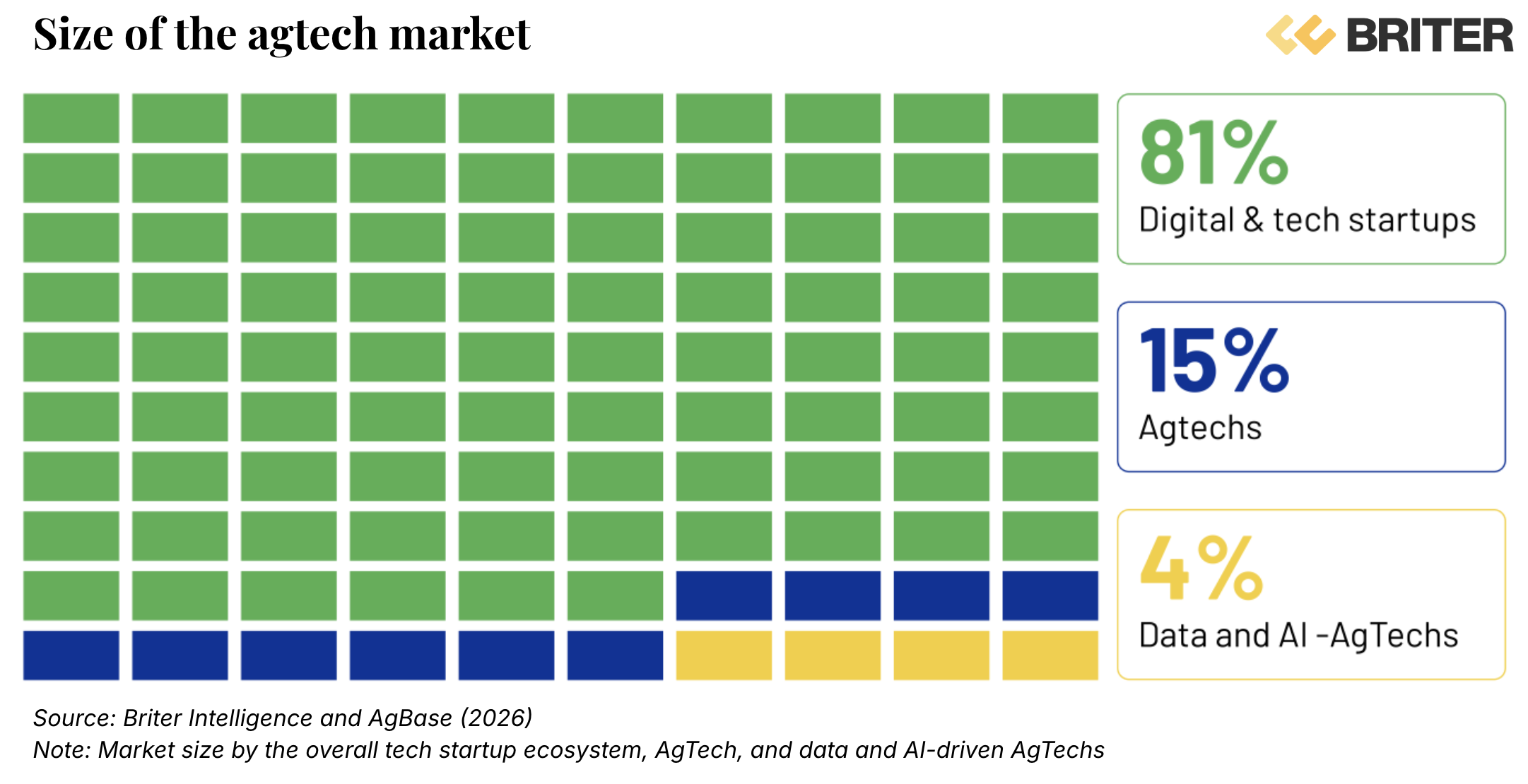
Despite the enthusiasm, the financial realities remain brutal. Briter’s deep dive into the agtech sector—in partnership with Digital Africa, found that while data and AI-driven agtech raised nearly $400 million across eight Sub-Saharan markets over the last decade, this represents a minuscule 2.5 percent of overall funding in those markets.
Furthermore, a critical voice emerging from the academic and policy spheres warns that the current regulatory frameworks are dangerously flawed. Writing for the Oxford Law Blog, scholar Samuel W. Ugwumba argues that the concept of “development” has become a trap. He points to Nigeria’s National AI strategy, which was “guided” by a Google report and co-created with Meta and Microsoft, arguing that “the regulated entities [are] co-authoring the framework that governs them.”
Mr. Ugwumba highlights a cautionary tale: the case of 140 Kenyan workers hired by Sama to label traumatic content for OpenAI for as little as $1.32 an hour. He argues that “development” discourse allows such extraction to be reframed as “partnership.”
The sovereignty stack key to building AI economy
Ambassador Thigo attempts to resolve this tension by defining AI sovereignty as a “full-stack problem.” He insists that Africa must control every layer: the data, the compute, the talent, and the governance.
“No country, no region, and no people should, in this era, outsource their intelligence,” Thigo wrote. His argument is not for isolation, but for leverage: to use the $2.9 trillion to $4.8 trillion projected economic impact of AI as a reason to build regional compute infrastructure and sovereign cloud capacity.
The data from Briter suggests the raw materials for this future exist. The continent has the brains (300+ firms), the use cases (agritech, health, finance), and the adoption rate (Kenya’s 97.5%). The next three years will determine whether those assets are used to build a local industry or simply to refine data for foreign algorithms.
Africa Forward summit comes just days before Nairobi plays host to the inaugural edition of AI Everything Kenya X GITEX Kenya summit taking place from 19–21 May in Nairobi. The showcase will see regional and global digital economy stakeholders to advance sovereign, inclusive, and investment-driven AI ecosystems debate across East Africa. The Inclusive AI Summit will take place at the Sarit Expo Centre on 19 May, followed by the AI Everything Kenya Expo and Conference on 20–21 May, at the Kenyatta International Convention Centre.
Read also: Nairobi’s New Asset Class Is Data: Why AI Economy Is Reshaping East Africa’s Investment Case