


- Telco’s taps Get-Phone Ltd to deploy 100,000 smartphones by December. The plan will see subscribers make a small upfront deposit, followed by regular repayments through Hormuud’s EVC Plus mobile money platform.
- Eligibility is determined using Hormuud’s telecom-based credit scoring system, which assesses how long a customer has used their SIM card and their mobile money spending patterns. Based on this, customers are placed into risk tiers and offered an appropriate device and payment plan.
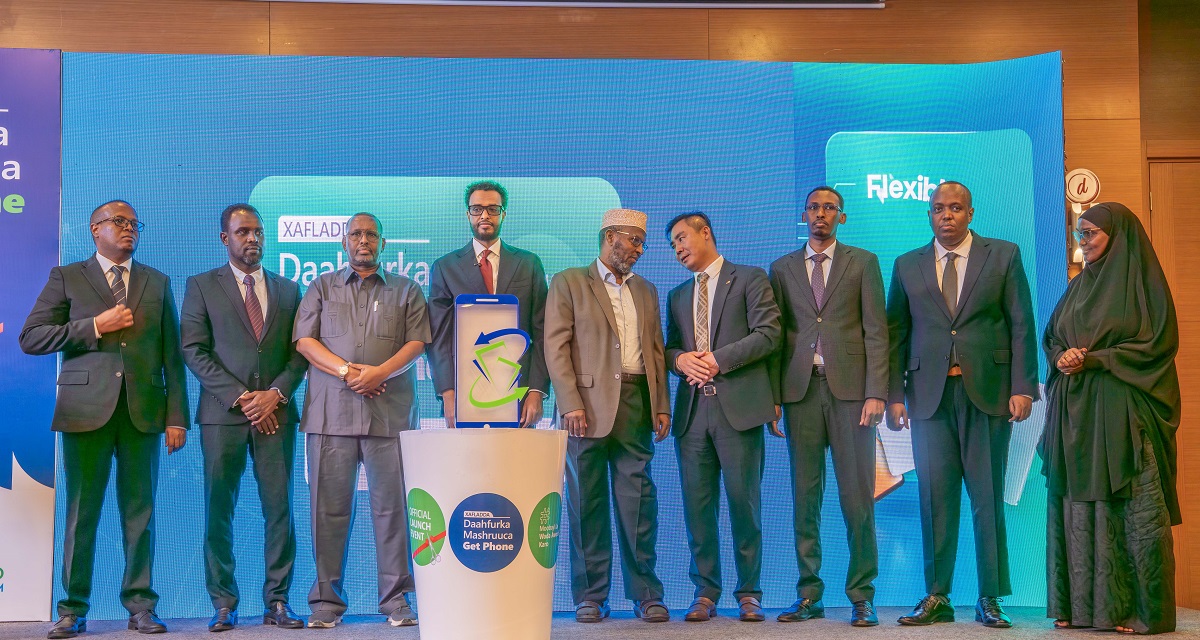
Somalia’s telco and mobile money provider Hormuud Telecom has entered into a partnership with Mogadishu-based Get-Phone, to roll out a smartphone financing programme in Central and Southern regions of the country, targeting millions of low-income users access smartphone devices for the first time.
In many low-income markets, both smartphone devices and data are expensive relative to incomes, limiting uptake even where developed networks exist. This programme is designed to address this affordability gap directly.
H.E. Salah Ahmed Jama, Deputy Prime Minister of the Federal Government of Somalia, stated: “A smartphone today is far more than a device; it is a gateway to commerce, education, financial inclusion, and opportunity. In the hands of our citizens, it becomes a powerful tool for empowerment and productivity.
This underscores the indispensable role of Somalia’s private sector in advancing our national aspirations under Vision 2060 – transforming ambition into tangible progress, and ensuring that opportunity is not abstract, but accessible to every Somali.”
The partnership will significantly reduce the upfront cost and subsidise the cost of data, so that for a small daily top-up on what many Somali customers already spend on connectivity, users gain access to both a smartphone and a daily bundle of data and calls.
The average customer currently spends around $0.50 for 1GB of data and 40 minutes of calls. Through the financing model, users can now pay $0.60 per day, covering both a smartphone and a daily bundle of 1GB data and 40 minutes of calls.
The aim is to make access affordable for lower-income users, on average earning $150 a month, and remove cost as the main barrier to participation.
The first phase of the programme will see 10,000 devices rolled out by June, with a further 100,000 planned by the end of the year as the initiative scales through expansion in Puntland and Somaliland.
Ahmed Yusuf, Chairman of Hormuud Telecom said, “For twenty years, we have built a network that we believe can transform Somalia. The barrier is not the mast in the distance; it is the handset in the pocket. Today, we are removing that barrier, and in doing so, delivering the last mile of infrastructure this country has been waiting for. For partners who see Somalia’s potential, the scale of what we can achieve together has never been greater.”
Impact of broadband on economy
Evidence from the World Bank and GSMA shows that access to mobile broadband can increase household consumption by up to 8 per cent and reduce extreme poverty by as much as 7 percentage points, while a 10 per cent increase in broadband penetration can increase GDP by up to 1.4 per cent in developing economies.
The initiative aims to unlock the full value of the country’s telecom infrastructure, which has expanded rapidly over the past two decades. Major investments from Hormuud have included introducing fibre optic connectivity in Somalia, co-financing two subsea cables, and launching the country’s first 5G service. Today, more than 70 per cent of Somalia’s population is covered by 4G internet.
Omar Abdi, Chief Executive Officer, Get-Phone said, “Somalia is one of the most dynamic, entrepreneurial societies in the world. This programme is built on the belief that when you give people access to the right tools at the right price, they will do extraordinary things with them. We are proud to be building that here, with Hormuud, for Somalia.”
The model has already been tested through a pilot in Mogadishu between February and March. The pilot focused on low-income users and tested both the financing model and technical integration. Default rates were below 4 per cent, with strong uptake across target segments. In many cases, customers acted as guarantors for devices on behalf of relatives, including family members in rural and nomadic areas. This family support helped extend access while reducing risk.
This initiative aligns with Somalia’s national transformation plan and Vision 2060 agenda. By expanding smartphone access, the programme enables participation in digital financial services, e-commerce, skills development, and economic opportunities.
Customers will be able to acquire smartphones through a simple and flexible financing model. Devices are provided with a small upfront deposit, followed by repayments made daily, weekly, or monthly through Hormuud’s EVC Plus mobile money platform.
Hormuud telecom credit scoring system
Eligibility is determined using Hormuud’s telecom-based credit scoring system, which assesses how long a customer has used their SIM card and their mobile money spending patterns. Based on this, customers are placed into risk tiers and offered an appropriate device and payment plan.
Once enrolled, customers leave with a smartphone preloaded with data and free calling minutes. A usage-based system ensures that services remain active as long as payments are made. If a payment is missed, access is temporarily restricted and the missed days are added to the end of the repayment period, rather than triggering penalties.
The programme runs over a 12-month, 9 or 6-month period, with data subsidised during this time. After the device is fully paid off, customers will continue to benefit from discounted data rates.
The initiative is supported by a fully integrated system linking device financing, mobile money payments, and service activation through Hormuud’s network. A 24-hour after-sales service is also being rolled out across major cities, alongside a network of agents and student sales representatives who will support onboarding and distribution.
Hormuud operates EVC Plus, Somalia’s most widely used mobile money platform, processing payments, transfers, and financial transactions for millions of Somalis every day. EVC Plus operates under the oversight of the Central Bank of Somalia and has become a critical pillar of the country’s financial infrastructure, serving households, businesses, and institutions across the country.
Read also: UNDP and Hormuud Salaam Foundation tie up to boost jobs in Somalia’s green and blue economy