



- When a continent spends $150Bn a year importing food it could grow itself, the problem isn’t a lack of intelligence, artificial or otherwise, it’s a catastrophic failure to scale the intelligence that already exists.
- At East Africa’s debut AI Everything Kenya x Gitex Kenya summit, agritech industry experts argue that smallholder farmers in the continent don’t need another app; they need the digital rails to turn fragmented contracts into one investable market.
For all the talk of artificial intelligence (AI) upending global agriculture, a paradox lies at the farmlands where Africa’s agritech startups are gearing up to lead a new revolution to feed the continent’s rising population. Economies in Africa budget between $90 billion and $150 billion per year to importing food ietms that could otherwise be grown in the continent.
At the debut AI Everything Kenya x Gitex Kenya organised by inD, the global organiser of GITEX events, in partnership with the Office of the Special Envoy on Technology of the Republic of Kenya, a panel of seasoned agribusiness leaders delivered a blunt assesment, noting that that the continnet’s problem is not a lack of innovation or capital, but a catastrophic failure for relevant innovations in the industry to scale.
“Africa does not have a lack of innovation. We have a lot of brains here. What we lack is scaling up and the ability to execute,” explained Vimal Shah, CEO of Bidco Africa, setting the tone for a deepdive that sought to expose what ails the continent’s agritech ecosystem.
Offering a real-world example, Thule Lenneiye, Chief of Staff at AGRA, shared her experience in a pilot project in Ethiopia that attempted to use a leading large language model for agricultural advice. The results were a case study in algorithmic colonialism, she noted.
“We gave the inputs, our scope, the variables, and we highlighted this is Ethiopia,” Lenneiye recounted. “The advice it gave was for an Iowa-based farmer on 200 hectares of potato.” She noted that while the push for local languages is welcome, the deeper issue is the “language of data.” Without localised training sets, she warned, agritech systems in Africa run the risk of “hallucinating” solutions that are simply irrelevant to smallholders farming on two hectares rather than two hundred.
The disconnect between global agritech industry AI models and realities in African firms
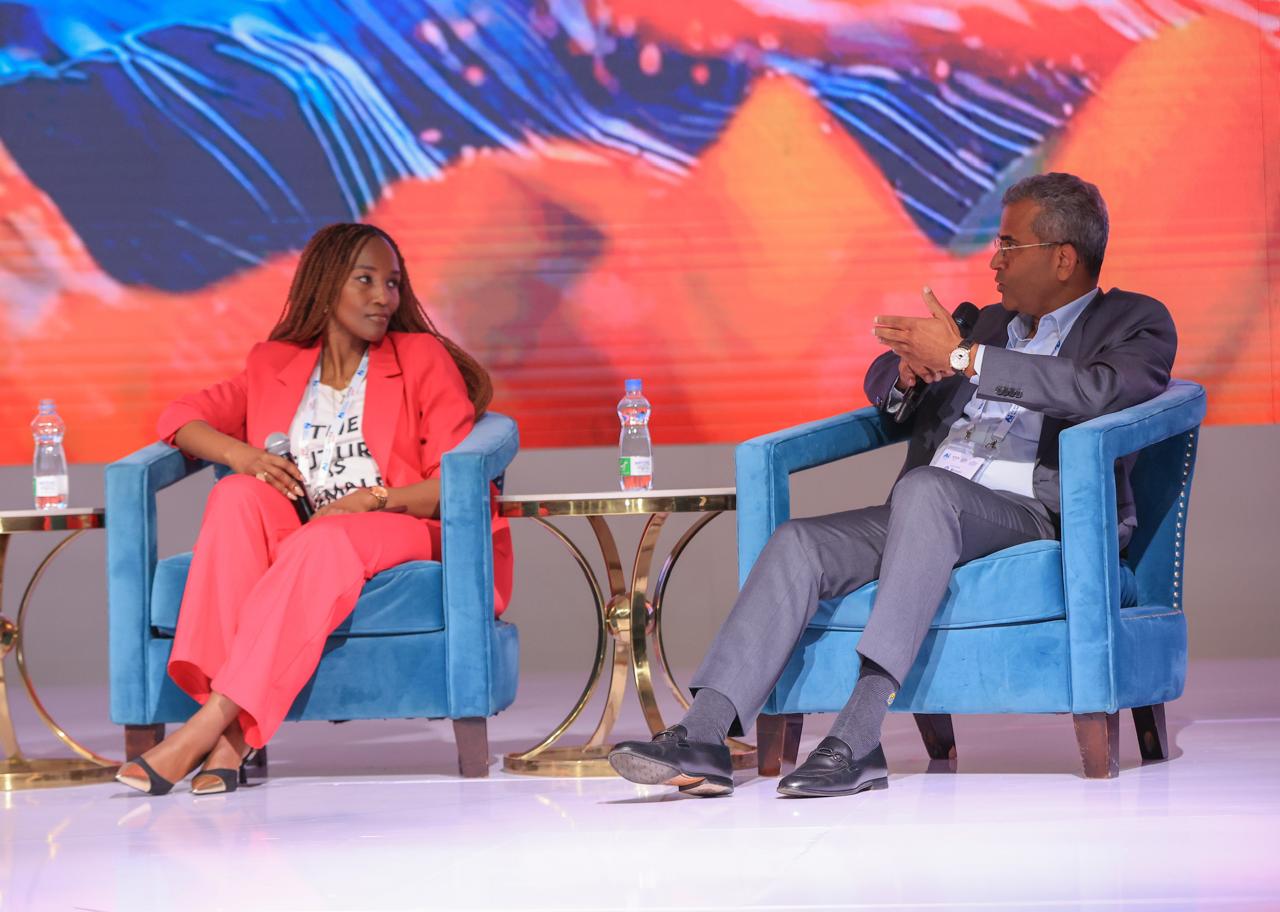
The disconnect between global AI models and local realities was a recurring theme during the panel headlined Building a Climate-Resilient Agriculture Engine, which was moderated by CNBC Senior Producer and Anchor Aby Agina. Ramesh Moochikal, CEO of Rwanda-based Africa Improved Foods (AIF), drew on his decade-old experience to argue that the continent could be regressing in data application.
“We used to pre-finance four million farmers across 21 different crops. At any point, we were $120 million to $180 million in the hole with these farmers, no collectors, no banking institutions,” Moochikal explained. A decade ago, his team used a system called ‘AdSource’ to track every one of those farmers. “Without digitising it, it was impossible,” he added, lamenting that while the tools have improved, the collective will to deploy them at scale has not.
On his part, Bidco Africa CEO Vimal Shah distilled the challenge into a framework of “Proof, Pipes, and Pull.” He noted that Africa has the “Pull”, that is, the demand as evidenced by the staggering $150 billion import bill (the continent’s spend last year, according to the panel). However, it is the “Pipes”, which encompass the infrastructure and data connectivity as well as the “Proof” (demonstrable, localised models) that are missing in the agritech ecosystem.
“We are a fragmented continent. 54 countries. 54 presidents. 54 types of mindsets,” Shah explained, adding: “We are all thinking like kings in our own system.”
Success stories that offer hope to agritech startups
Despite the fragmentation, the panelists pointed to concrete, albeit isolated, successes that offer a blueprint. Shah described Bidco’s operations in Uganda where the company has 50,000 acres of palm oil plantations where every tree is geotagged and mapped like cells in a back office Excel spreadsheet. “On February 14th, everyone wants a red rose delivered in Holland. The supply chain works like clockwork on precision farming,” he said. “Here on the equator, we have 12 hours of free sun every day. We have the assets. We lack the policy incentives.”
Moochikal offered a rare success story from Rwanda, where AIF has tripled maize yields in seven years. “We are the largest grain buyer in the country. We have employed drones for 200 cooperatives,” he said. However, he noted the cost barrier, about $30 per hectare for a drone is prohibitive for most smallholders, so AIF absorbs the cost. “We used to have a country south of Kenya—I will not name it—where we spent eight years advocating to change cotton seed that was 33 generations old,” he said. “But in Rwanda, the government is proactive and open to ideas.”
Read also: Can Africa’s vast natural gas wealth power the continent’s digital future?
Financing agriculture: De-risking the ‘risky’ asset class
Perhaps the most potent exchange came during the Q&A, when a summit delegate from Ghana challenged the panel on the Africa-wide urban-rural divide that still stalks agribusiness value chains. “How are you going to apply industrial farming technology to local people?” he asked, noting that his firm had resorted to converting AI data into podcasts for radio because farmers lack smartphones.
Shah’s response was a direct appeal to the technologists in the room. “Stop sending apps to farmers. Do not give them another app. Create a system. Collaborate,” he said. He revealed that edible oil maker Bidco Africa currently works with 30,000 contract farmers in Kenya alone. “Servicing those 30,000 farmers, getting their paperwork, is tough. AI and digitisation would make it a breeze. We need the rails.”
He concluded with a stinging critique of players in development finance. “If you are a financier here, you will never put your money in agriculture. Even IFC and the World Bank see agriculture as risky,” Shah argued. “We need to de-risk the model using AI—the water, the sun, the nutrients, and the markets. That is what AI was built for.”
Read also: AI Everything Kenya x Gitex Kenya stirs Nairobi as East Africa embraces new AI blueprint
Looking forward: How can better seeds and Intra-African trade power agritech sector
As the panel wrapped, the three executives offered three distinct, actionable takeaways. For Moochikal, the priority is primal: “The most basic problem requiring digitisation and AI support is the quality of the seed we use across the continent. Change it.”
For Lenneiye, the math is the message. “The food import bill is $90 billion a year, minimum. Last year it was $150 billion,” she said. “The opportunity is staring us in the face. We need to build rails for intra-Africa trade in a smart way.”
Shah had the final word, rebranding the acronym for effect. “AI is not just artificial intelligence. It is agriculture intelligence. If we de-risk the model, we will not have poor farmers. We will have rich farmers.”
The panel ended with a sobering consensus, noting that there are thousands of pilots running across the continent, but without digital public infrastructure, honest collaboration, and a hard pivot away from copying Iowa, Africa’s agritech revolution will remain a collection of promising spreadsheets, not a transformed breadbasket.
Read also: African startups rewrite the AI playbook at AI Everything Kenya x Gitex Kenya 2026