

Trending
- African trade is growing despite the obstacles
- Why global capital is betting big on Africa’s digital promise
- Kenya posts stronger-than-expected Q1 growth at 5.3% on manufacturing rebound, tourism boom
- China’s new investment rules are about guardrails, not closed doors
- Zanzibar optimistic economic growth will hit 7.5% on tourism boom
- Kenya defies economic shocks to post record $22 billion in tax collections
- Forget South Africa: East Africa now rules in banking industry returns
- Lamu over Tanga: The commercial calculus that cost Tanzania $20bn refinery



Zanzibar legislators project 7.5% economic growth. President Mwinyi advocates private sector participation. Zanzibar recent talks with Brazil, US expected to bare fruits. Zanzibar has…
KRA reports record KES2.84 trillion (up 10.6%) in tax collections,…

UAE has cemented its spot as the main refining, and…



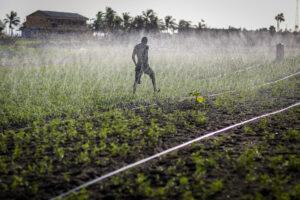
There are twenty-two irrigations projects under GIDA, covering 6,505 hectares. Additionally, there are twenty-two schemes constructed under the Small Scale Irrigation Development Project (SSIDP) and six schemes under the (Small Farms Irrigation Project) SFIP.
The SSIDP and the SFIP projects are all less than 1,000 hectares in size, except for the Tono and Kpong Irrigation Projects, which have about 2,500 hectares and are overdeveloped.
The primary beneficiaries of the irrigation projects have been indigenous small-scale farmers. However, the outputs have not been very encouraging, and the lack of maintenance of the projects has rendered most of the schemes unproductive.
Moreover, 14 companies have been enlisted and have taken up more than 3,000 hectares of land to cultivate commercial farming operations.
World Bank further notes that the unified digitisation of the East African economy is estimated to generate up to a US$2.6 billion boost in GDP and 4.5 million new jobs that will largely benefit those at the bottom of the pyramid.
Data by GSMA reveals that by the end of 2020, 495 million people subscribed to mobile services in Sub-Saharan Africa, representing 46 percent of the region’s population, an increase of almost 20 million on 2019.
GSMA revealed that smartphone connections will more than double by 2025 in Sub-Saharan Africa with the East African Community registering the largest incremental growth, led by Rwanda and Tanzania.
The project uses a comprehensive approach to combat cancer, involving communities and building capacity to over 400 community health care workers, and raising awareness by printing and distributing over 3,000 books and 5,000 Information, Communications and Education (ICE) materials.
“This project aims to complement the government efforts towards reducing cancer morbidity and mortality,” said Minister of Health Ummy Mwalimu.
“The government cannot single-handedly combat the growing burden of cancer, hence we commend TCCP for their innovation towards demonstrating the success of public-private collaboration to control cancer in the country,” she added.
The Presidential Council for Africa (PCA), founded by President Emmanuel Macron in 2017, is driving this project. Its coordinator, Wilfrid Lauriano do Rego, told RFI that each student’s case will be examined separately.
“Each student presents a different case depending on whether they would like to continue studying in France or not and whether French universities can take them. And we also need to liaise with the French authorities to make this project feasible,” he said.
The initiative is not limited to francophone students but is open to anglophone students too, depending on how fluent they are in French. The project concerns all university courses but may be limited to what is on offer within the French universities participating in this initiative.
“It will also depend on what kind, of course, they are following and the decisions of the French universities giving these courses on the matter,” he said.
Three hundred African students have, so far, enrolled in the PCA’s initiative. Lauriano do Rego said that he doesn’t know, at present, if they can accommodate more students as it depends on the student’s achievements.

President Uhuru Kenyatta has ordered a countrywide security crackdown to weed out rogue boda boda…

The former Federal Inland Revenue Service (FIRS) chairman, Babatunde Fowler, announced Nigeria’s decision to tax digital transactions in 2019. The new legislation dubbed The Finance Act (2021) was signed on December 31, 2021.
A section on Nigeria’s Finance Act focuses on capturing value from non-resident technology companies and calls them to act as VAT collectors for digital goods and services traded within Nigeria. The minister for finance, budget and national planning, Zainab Ahmed, said during the presentation of the 2022 budget that the taxable digital platforms include apps, high-frequency trading, electronic data storage, online advertising, and several others.
In addition, Meta had already issued a notice on December 9, 2021, before releasing the new financial regulation, saying that Meta ads in Nigeria would be subject to a value-added tax (VAT) at the applicable local tax rate. The VAT applies to advertisers whose “Sold to” country on their business or personal address is set to Nigeria. Meta has 26.10 million users in Nigeria in early 2022, equivalent to 12.2 per cent of the population in Nigeria.