



- Across Africa, AI systems are reshaping the architecture of war, lowering the barrier of entry for terrorists and insurgencies to thrive, automating disinformation, and determining who gets food aid or a bullet.
- Current peace and security predictive systems are built on information that reflects the institutional priorities of external funders rather than the granular, on-the-ground reality of local communities such as land disputes, fights over water, pasture or evolving market dynamics.
From Sudan’s war-torn Al Fasher and Kordofan, where the Rapid Support Forces (RSF) have intensified their grip on poor villages, to the trending conversations in Kenya’s hyperactive social media scene that often border on hate speech, the impact of artificial intelligence (AI)-powered systems on peace and security in Africa is rising fast.
AI systems are changing the scales in conflict zones, leaving governments at a crossroads as foreign-owned cloud servers dictate the terms of engagement for peace and security actors.
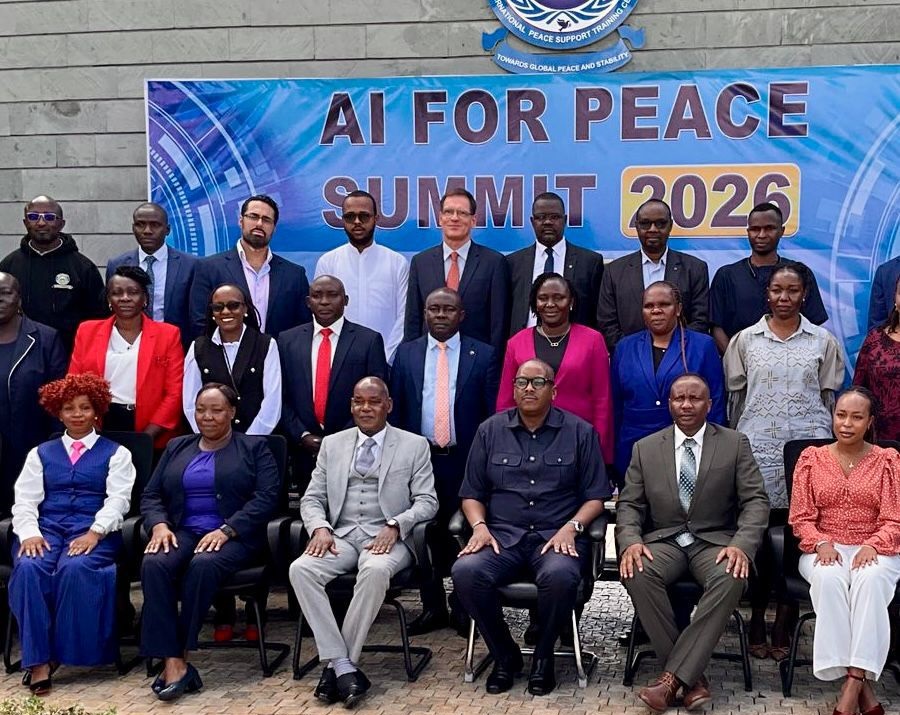
In a room filled with senior Kenya Defence Forces officers, tech gurus, civil society, and the intelligence community at Nairobi’s Humanitarian Peace Support School (HPSS) on Friday, 24 April 2026, high-level talks highlighted the creeping use of AI systems in warfare and conflict across Africa, and how the emerging technology could be deployed, albeit with challenges, to achieve peace and security goals.
The AI for Peace Africa 2026 summit held in Nairobi under the theme “Advancing Artificial Intelligence for Peace, Governance and Resilience in Sub-Saharan Africa,” was organised by AI for Peace Africa founder Naomi Kilungu in collaboration with the Open Society Foundations, AEthics.ai, and the International Peace Support Training Centre.
Keynote speakers highlighted that Africa is no longer a battleground for critical minerals such as cobalt. A fierce scramble for data and information is underway, and the weapons being deployed by big tech firms are algorithms.
Across economies in Africa, AI is reshaping the architecture of war, lowering the barrier for terrorists and insurgencies to thrive, automating disinformation, and determining who gets food aid or a bullet.
The Nairobi summit was framed by urgent warnings against passivity. “Africa must be an architect of AI-enabled peace, not just a consumer of these emerging technologies,” warned Major General John Nkoimo, General Officer Commanding Central Command in Kenya.
Major Gen Nkoimo’s sentiments were echoed by keynote speaker, Ambassador Fred Ngoga Gateretse, Senior Advisor on International Partnerships, the AU Border Programme, and Regional Security Mechanisms at the African Union Commission (AUC).
Ambassador Ngoga observed that global powers are in a frantic search for critical minerals in Africa, and their ‘predatory approach’ is fast expanding into the continent’s nascent AI-powered digital economy. For stakeholders in Africa’s peace and security space, the continent’s 21st century is likely to be shaped and defined by a tough struggle for digital sovereignty.
Africa’s fragile early warning systems
While panelists cited the deployment of early warning systems capable of predicting violence between ethnic communities, quite often, these platforms experience failure. Experience shows that early warning information systems fail to produce corresponding counter-action in time.
Ambassador Ngoga highlighted that while data is being crunched, the pathways to turn that analysis into appropriate peace and security measures such as mediation are a challenge in many countries.
“Our regulatory frameworks are not keeping pace with AI and emerging technologies. AI does not create new conflicts; it amplifies existing vulnerabilities. Where institutions are weak, AI deepens instability; where societies are divided, AI sharpens divisions; where governance is absent, AI fills the vacuum,” explained Ambassador Ngoga in his keynote address.
The forum observed that Africa’s fragmented and or absent AI policy problem is compounded by existence of biased datasets.
Currently, predictive systems are often built on information that reflects the institutional priorities of external funders rather than the granular, on-the-ground reality of local communities such as land disputes, fights over water, pasture or evolving market dynamics. If the data is flawed, the “peace” algorithm will amplify, rather than mitigate existing structural biases.
AI- systems link in fake news, hate, divisions, and deep fakes
Already, the monumental tragedy of fake news, misinformation, and deep fakes is claiming casualties in Africa, and leaving fragile economies vulnerable amid the proliferation of autonomous weapons.
“AI is transforming information warfare. Deep-fake videos, fake news, and automated bot networks are already distorting reality at scale. In fragile ecosystems, this is not just a political issue; it is a trigger in situations battling with political violence, ethnic tensions, and a direct assault on public trust,” noted Ambassador Ngoga.
Across hotspots in the Sahel and the Horn of Africa for instance, the nature of armed conflict is assuming a frightening trajectory. Major General Nkoimo revealed that low-cost drones and semi-autonomous systems are spreading rapidly in conflict areas.
“In Africa, there is a total or near-total absence of regulatory frameworks [on the use of AI-powered weapon systems],” the Major General stated.
This gap risks transforming conflict zones into unregulated laboratories for the use of lethal autonomous weapons, including by foreign actors. Without accountability, the risk of miscalculation, or intentional atrocity, skyrockets significantly.
The summit noted that non-state actors, including terrorist groups such as Somalia-based Al-Shabaab and ISIS-affiliated militias spread across the continent, are harnessing AI-powered platforms to “behave like sophisticated state entities,” effectively tailoring propaganda, translating messages across languages, and coordinating surveillance via drones.
Research presented at the summit showed that roughly 60 per cent of disinformation campaigns targeting Africa are sponsored from foreign capitals, primarily global powers in cut throat fight for geopolitical leverage.
Social media safeguards, which are designed primarily for English speaking communities, fail to catch hate speech or incitement narratives often delivered in other languages such as Swahili, Hausa, or Amharic.
Specific flashpoint in the electoral cycle across countries in the continent, such as upcoming polls in Ethiopia and South Sudan later this year was cited. Kenya, a country with an hyperactive social media community and which is set to go into a General Election in August 2027, was cited under countries to watch during panel discussions.
Data shows that at least 17 African countries are poised to hold high-stakes elections in 2025-2026, and the potential of competing parties to using AI systems to spread misinformation or to inflame ethnic tensions is a top-tier risk.
Peace and security experts observed that a fake audio clip leaked hours before a crucial vote could trigger violence that a peacekeeper may struggle to stop.

Data sovereignty and the frightening reality of ‘digital colonialism’
One of the most unsettling realities among summit delegates was the pertinent question of data sovereignty, as more and more AI firms harvest huge volumes of content from Africa, and store it in cloud servers governed by strict foreign laws.
As data turns into new oil in value globally, panelists observed that tech giants are generating billions in revenue from this strategic resource while the digital economy in Africa remains nascent and overly extractive.
Furthermore, the continent’s 2,000+ languages are marginalized in today’s large language models, alienating the vast segment of Africa’s 1.4 billion people from the benefits of a thriving digital economy.
“Where institutions are weak, AI deepens instability,” Ambassador Ngoga cautioned, adding: “Where societies are divided, AI sharpens divisions.”
To help strategically position African economies better, Mediapix Founder and Managing Director Aly Ramji challenged governments to double down on their investments in people.
Aly observed that by eliminating the cancer of graft, and directing strategic investments in new tech could see the continent’s talent compete globally, and help shape Africa’s AI market, which is projected to cross $3 billion in value by 2030.
“If African governments invest in people, fight corruption meaningfully, and build aspirational economies, they can then leverage their own natural resources, the continent can compete globally and reclaim its voice in shaping AI policy. Otherwise, Africa risks being consumers of systems that do not reflect our languages, our realities, or our future,” Aly highlighted.
The summit concluded that it is no longer enough for Africa to simply adapt to AI offerings, stakeholders must collaborate in coding the rules of the game.
While the launch of the Nairobi Declaration on Ethical AI is a remarkable first step for the continent, the real work lies in developing binding continental conventions on emerging tech.
The African Union’s framework on AI governance is a starting point, but speakers called for specific protocols on autonomous weapons (similar to the CCW debates in Geneva) and military-grade data security safeguards.
As the sun set over the HPSS in Nairobi’s Embakasi area, Major General Nkoimo’s final challenge hung in the air. He turned to the youth and innovators in the inaugural AI for Peace Summit, the demographic majority of a continent facing the wave of new tech.
“Your voice is not supplementary to this process,” he counselled. “It is essential.” The question remains whether that essential voice will be heard before evolving AI algorithm pulls the trigger, further weakening ongoing peace and security efforts.
Read also: The Impact of U.S.-Israel War on Iran on Peace and Security in Africa
AI Everything Kenya x GITEX Kenya 2026 summit
The conversation on Kenya’s AI ecosystem and Africa’s stake in the emerging tech is expected to continue between 19 and 21 May 2026, when Nairobi hosts the AI Everything Kenya x GITEX Kenya 2026 summit. The global summit is structured across two venues: Inclusive AI Summit at the Sarit Expo Centre, and a larger expo and conference at the iconic Kenyatta International Conference Centre.
Participants drawn form policymakers, venture capitalists, the media, development finance institutions, and private equity players will engage in insightful conversations on Africa’s AI market, which is forecast to hit $3 billion in value by 2030.
President William Ruto’s Envoy on Technology Ambassador Philip Thigo states on the summit’s official portal that the summit marks a departure from legacy technology models. “Africa’s tech ecosystem is vibrant and purpose-driven,” he highlights. “Instead of replicating legacy models, we are building new ones through innovations in food systems, healthcare, education, and governance. Every innovation serves the mission to uplift lives, bridge gaps, and build futures.”